
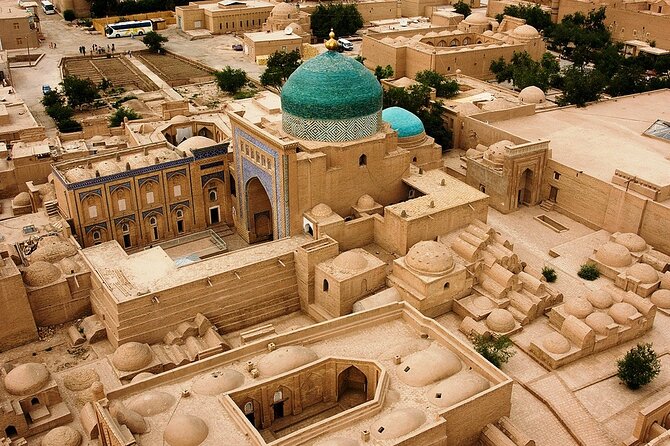
Reviewed · CITY TOURS
Khiva City Tour
Khiva rewards slow looking. This private city tour brings you through Itchan Kala, a remarkably preserved walled city filled with mosques, palaces, madrasahs, and mausoleums. I like the way the route gathers Khiva’s major sights into one day, and I especially like that entrance fees, lunch, and an air-conditioned vehicle are included. The main drawback is pace: eight stops in five to seven hours can leave you admiring some buildings quickly rather than studying them at length.
The tour also gives you a useful introduction to Khiva’s unusual setting. This is an ancient city in a desert oasis, with traditional crafts and blue-tiled monuments appearing around nearly every turn. Food may be the weak point, since one account found the Terrace restaurant meal average and overpriced, so I would treat lunch as convenient rather than a major reason to book.
In This Review
- Key points to know before you book
- Why Khiva feels different from other Uzbek cities
- Entering Itchan Kala, Khiva’s walled inner city
- Islam Khodja Complex and its blue-tiled religious setting
- Muhammad Amin Khan Madrassah and the story told by tile
- Kuhna Ark, the khan’s fortress and residence
- Kalta Minor, Khiva’s unfinished blue landmark
- Tash-Hovli Palace and the private world of the khan
- Pahlavan Mahmoud Mausoleum and the city’s spiritual side
- Juma Mosque and its forest of wooden columns
- Is $99 a fair price for this Khiva tour?
- Timing, private format, and who should book
- Should you book the Khiva City Tour?
- FAQ
- Where does the Khiva City Tour take place?
- What time does the tour start?
- How long does the tour last?
- Is the tour private?
- What is included in the price?
- Is pickup offered?
- Which major sights are visited?
- Can I cancel for a full refund?
- What happens if the tour is canceled?
Key points to know before you book
- Itchan Kala is the heart of the experience: The UNESCO-listed inner city concentrates centuries of Uzbek architecture behind defensive walls.
- Eight major sights are covered: You visit the Islam Khodja Complex, Muhammad Amin Khan Madrassah, Kuhna Ark, Kalta Minor, Tash-Hovli Palace, Pahlavan Mahmoud Mausoleum, and Juma Mosque.
- The price includes useful basics: At $99 per person, you get an air-conditioned vehicle, entrance fees, and lunch.
- The tour is private: Only your group takes part, which makes it easier to ask questions and adjust attention between sights.
- The schedule begins at 9 a.m.: Expect a full morning and afternoon, with the total experience lasting about five to seven hours.
- Khiva may be the highlight of an Uzbekistan trip: A late September visit described the old city as the most beautiful part of an 11-day journey.
Why Khiva feels different from other Uzbek cities
Khiva is not simply a collection of separate monuments. Its greatest pleasure comes from the way the old city holds together as one setting. Inside the walls of Itchan Kala, you move among religious buildings, royal residences, narrow streets, tiled gateways, and working craft traditions.
The city was founded in the 17th century, while many of the buildings you see date from the 17th through 19th centuries. That gives the visit a clear sense of place. You are not driving from one isolated ruin to another. The old city itself is the main attraction.
I would come here for the visual unity. Khiva repeats certain colors and forms: blue glazed tile, carved wood, domes, courtyards, towers, and decorated façades. The result is easy to remember, but it is not a polished theme park. The buildings still show the scale and layout of a Central Asian city shaped by religion, court life, education, trade, and local crafts.
The desert oasis setting adds another layer. Khiva’s position makes its architecture feel even more striking, since the rich decoration appears in a dry environment far from the grand capitals most people know from European history. A good guide can help connect the buildings to the city’s religious and political life, rather than letting the tour become a quick hunt for photographs.
More City Tours in Khiva:
- Khiva: Historical City Highlights Guided Walking Tour
★ 4.8 · 156 reviews - Khiva Historical City Highlights Guided Walking Tour
★ 5.0 · 30 reviews - Private Samarkand City Tour With Transportation
★ 5.0 · 149 reviews
Entering Itchan Kala, Khiva’s walled inner city
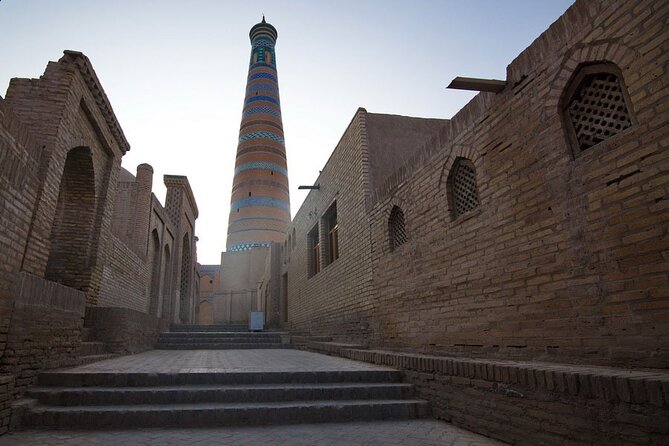
The tour begins with about an hour in Itchan Kala, and this is the essential first step. The inner city is a UNESCO World Heritage Site and one of the best-preserved examples of a medieval Central Asian city.
The most useful thing about starting here is orientation. Before you focus on one minaret or palace, you get a feel for the whole enclosed city. Its walls, historic buildings, and compact streets show how Khiva once functioned as a seat of power and faith.
You can expect to see palaces, mosques, madrasahs, and mausoleums from several centuries. The one-hour allocation is enough to introduce the setting, but it is not enough for every detail. If you are a serious architecture fan, you may wish the tour spent longer here, especially since the remaining stops also move at a brisk half-hour pace.
The old city is where Khiva feels most like a living museum. Traditional crafts are part of the experience, and the setting allows you to see how decorative skills remain tied to the city’s identity. I would keep your eyes at street level as well as on the domes and towers. The smaller details often explain more about Khiva than the grandest façade.
Islam Khodja Complex and its blue-tiled religious setting
The Islam Khodja Complex receives about an hour, making it one of the longer stops. The complex includes the Islam Khodja Mausoleum, a late 19th-century religious structure connected with Ismail Khodja, described as a Sufi leader and poet.
This is a stop for close inspection. The tilework and carved details show how Uzbek builders combined traditional Islamic forms with local architectural style. Blue domes and a carefully decorated façade give the site its strong visual character.
The hour matters here. Instead of only pausing for a photograph, you have some time to look at the tile patterns, the façade, and the relationship between the complex and the surrounding old city. If your guide explains the religious role of the mausoleum and its connection to Khiva’s spiritual life, this stop can become more meaningful than its attractive exterior suggests.
The complex is also a reminder that Khiva’s history is not only about khans and fortresses. Religious teachers, poets, saints, and scholars shaped the city too. That balance is useful, especially if you are comparing Khiva with Samarkand, where monumental scale often takes center stage.
Muhammad Amin Khan Madrassah and the story told by tile
The Muhammad Amin Khan Madrassah gets 30 minutes. Built in the 19th century and named for the governor of Khiva at the time, it follows the classic madrassah plan with a central courtyard, decorated façade, and domed roof.
The courtyard is the key feature to notice. Madrassahs were centers of Islamic education, and the design gave students and teachers an organized setting around which daily life revolved. The ornate tilework and calligraphy add beauty, but the building is also evidence of how education was structured in historic Khiva.
Half an hour is reasonable for a first visit. You can take in the exterior, look into the courtyard, and study the decorative work without spending too much time in one place. Still, the stop may feel short if you want a detailed explanation of the inscriptions or architectural techniques.
This is one point where a private tour helps. You can ask your guide to explain what the calligraphy says or how the madrassah differed from the nearby palace buildings. The tour is better when you use that flexibility rather than simply following the group from doorway to doorway.
Same stretch of the Silk Road, a different sort of day:
- Transfer: Bukhara – Khiva via Ancient Fortresses
★ 4.5 · 101 reviews - Daytrip From Khiva To Ancient Fortresses
★ 4.6 · 60 reviews - Aral Sea Adventures (2 day)
★ 5.0 · 30 reviews - Private Daytrip to 7 Ancient Fortresses of Khorezm
★ 5.0 · 25 reviews
Kuhna Ark, the khan’s fortress and residence
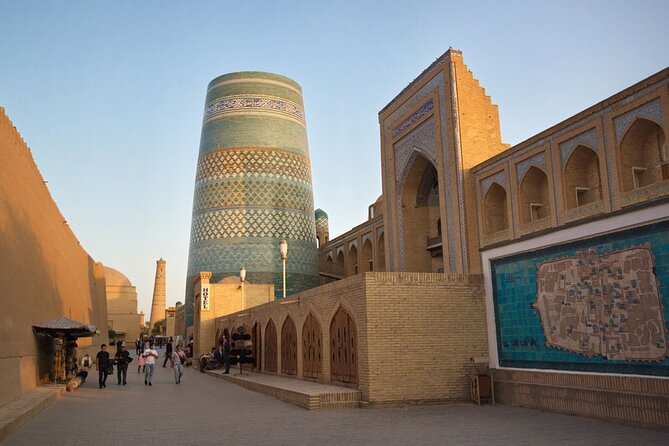
Kuhna Ark is a centuries-old fortress and former residence of Khiva’s rulers. Its blue tiles, ornate gateway, and two flanking towers make the entrance easy to recognize.
The site brings political power into the picture. After seeing religious schools and mausoleums, you get a clearer sense of where the khan’s court operated and how royal life differed from ordinary city life. The fortress is not just another decorated building. It represents government, residence, ceremony, and defense in one compound.
The scheduled 30 minutes gives you a quick look. I would pay attention to the gateway and the way the fortress separates itself from the surrounding streets. If you want a long exploration of every room and courtyard, the time may feel limited, but the stop works well as part of a wider introduction to Khiva.
The fortress also helps explain why Khiva can feel larger than its compact streets suggest. Behind the walls was a political center with its own spaces, rules, and hierarchy.
Kalta Minor, Khiva’s unfinished blue landmark
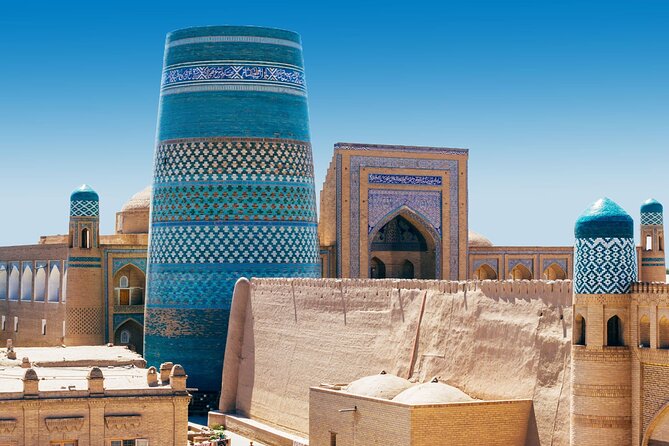
Kalta Minor is one of Khiva’s most recognizable sights. The 19th-century tower was intended to become the tallest minaret in the world, but construction stopped before the project was completed. It is described as reaching about 70 meters and is decorated with brick and tile, including a colorful zigzag design compared with a viper’s head.
The unfinished nature of the tower is part of its appeal. You are looking at ambition made visible. Rather than a perfect completed monument, Kalta Minor preserves the evidence of a plan that ran out of time, money, or political support.
The 30-minute stop gives you enough time to appreciate its scale and decoration. I would look closely at the patterning instead of viewing it only as a tall blue object. The surface decoration is what makes the tower distinctive.
The supplied information describes the tower as offering views of Khiva and the surrounding desert, but you should confirm on the day whether access is available. Even from ground level, Kalta Minor is a strong visual marker and helps you understand the density of monuments inside Itchan Kala.
Tash-Hovli Palace and the private world of the khan
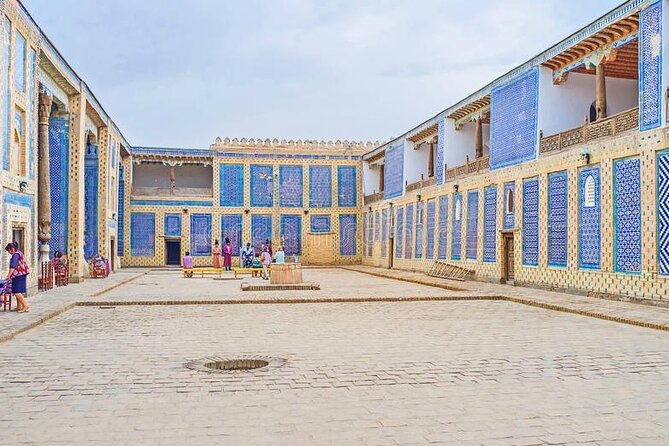
Tash-Hovli Palace was built in the 19th century as a residence for the khan and his family. Today it functions as a museum, with rooms that include an audience hall, bedrooms, and private quarters.
This is one of the best stops for seeing how royal life was organized. The palace’s courtyards, tilework, and carved decoration are not simply ornamental. They separate public business from family life and show how a ruler’s residence could operate as both home and court.
The half-hour visit will likely focus on the major rooms and courtyards. I would look for the contrast between formal spaces and more private areas. The audience hall tells one story about authority, while the family rooms show a more domestic side of the palace.
Exhibits of traditional costumes, ceramics, and jewelry add useful cultural context. They help turn the palace from an empty architectural shell into a place connected with daily life and local craftsmanship. If you enjoy decorative arts, this stop may hold your attention longer than the schedule allows.
Pahlavan Mahmoud Mausoleum and the city’s spiritual side
The Pahlavan Mahmoud Mausoleum dates from the 14th through 18th centuries and honors Pahlavan Mahmoud, a famous Central Asian wrestler and saint. Its dome is covered in blue glazed tiles and sits above a rectangular base.
This is a particularly interesting combination of athletic fame and religious devotion. Pahlavan Mahmoud was remembered not only for physical strength but also as a holy figure, giving the mausoleum a different character from a royal tomb.
Inside, you can expect decorated surfaces that include frescoes and wood carvings. The exterior dome attracts the eye first, but the interior deserves attention. Look at the contrast between glossy tile, painted decoration, and carved wood.
The tour allows 30 minutes here. That should be enough to appreciate the main design and hear the basic story, though the atmosphere may encourage you to linger. This is a good place to ask your guide about how saints and local heroes were honored in Uzbek culture.
Juma Mosque and its forest of wooden columns
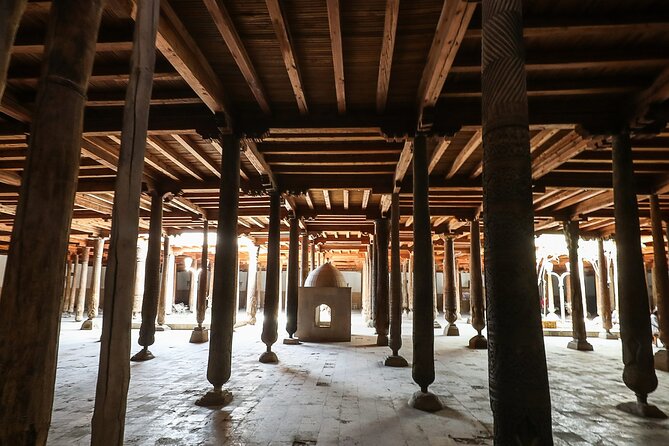
The Juma Mosque is described as one of Khiva’s oldest and largest mosques, dating to the 10th century. Its spacious interior can hold up to 2,000 worshipers and is known for wooden columns and ornate carvings.
The columns are the reason to pay close attention. They create a forest-like interior, with repeated vertical forms supporting the roof and giving the mosque a calm, measured feel. This differs sharply from the bright exterior tilework found elsewhere in Itchan Kala.
The mosque also includes a central dome, smaller domes, tilework, and calligraphy. The 30-minute visit is enough for a broad look at the interior and its carved details. You may find that the wooden work rewards patience more than a quick photograph.
For me, this stop helps round out the tour. Khiva is famous for blue towers and palace façades, but the Juma Mosque shows another side of the city: older, quieter, and more focused on structure and worship.
Is $99 a fair price for this Khiva tour?
The price is $99 per person. That is not a bargain-priced walking tour, but the value depends on how you would otherwise arrange the day.
The cost includes an air-conditioned vehicle, entrance fees, and lunch. It also covers a private experience, so only your group participates. Those inclusions matter in Khiva, particularly if you want a single organized route through many historic sites rather than handling each admission and transfer yourself.
I would judge the price favorably if you want convenience and a guide-led overview. Eight major stops, transport, admissions, and lunch can make the fee reasonable for a first visit. The value is weaker if you prefer to move slowly, spend hours inside one monument, or arrange a simple self-guided walk through Itchan Kala.
Lunch should be treated as practical fuel. One account found the Terrace restaurant food average and overpriced. That does not ruin the day, but it is useful to keep expectations modest. The monuments, not the meal, are the main reason to pay for this experience.
Timing, private format, and who should book
The day starts at 9 a.m. and lasts about five to seven hours. That range probably reflects the pace of your group, time spent at each site, and the practical movement between stops.
Because this is a private tour, you do not have to match the interests of a large group. You can ask for more explanation at the Juma Mosque, spend extra attention on tilework at the Islam Khodja Complex, or request a little more time at Tash-Hovli Palace if the guide and schedule allow.
I think the tour suits first-time visitors who want a strong overview of Khiva in one day. It is also a good fit if you value included transport, admission tickets, and a planned route. People interested in architecture, Islamic art, Uzbek court life, and historic cities will find plenty to study.
I would be more cautious if you already know Itchan Kala well or want a slow photographic walk. The schedule is broad rather than leisurely. You will see many sites, but you may need to return independently to your favorites.
The tour requires good weather and a minimum number of participants. If poor weather or insufficient participation causes cancellation, you are offered another date or experience, or a full refund. You can cancel for a full refund up to 24 hours before the start time. Confirmation arrives when you book, and the tour is described as suitable for most people.
Should you book the Khiva City Tour?
Book it if you want the major monuments covered efficiently, with admissions, lunch, air-conditioned transport, and a private format bundled into one day. Khiva itself is the star, and the chance to see the UNESCO old city, royal palaces, religious buildings, mausoleums, and the unfinished Kalta Minor makes this a strong introduction.
Skip it if your priority is independence, quiet study, or saving money through a self-guided visit. The food may not impress, and the fast sequence of half-hour stops can feel rushed.
My practical advice is to book this tour for your first day in Khiva, then return on your own to the places that catch your eye. That approach gives you both a useful framework and time for the old city’s smaller details, craft shops, courtyards, and blue-tiled corners.
FAQ
Where does the Khiva City Tour take place?
The tour takes place in Khiva, Uzbekistan, with the main sightseeing inside Itchan Kala, the inner walled city.
What time does the tour start?
The stated start time is 9:00 a.m.
How long does the tour last?
The tour lasts approximately five to seven hours.
Is the tour private?
Yes. Only your group participates in the activity.
What is included in the price?
The $99 price includes an air-conditioned vehicle, entrance fees, and lunch.
Is pickup offered?
Yes. Pickup is offered for this experience.
Which major sights are visited?
The route includes Itchan Kala, the Islam Khodja Complex, Muhammad Amin Khan Madrassah, Kuhna Ark, Kalta Minor Minaret, Tash-Hovli Palace, Pahlavan Mahmoud Mausoleum, and Juma Mosque.
Can I cancel for a full refund?
Yes. You can cancel at least 24 hours before the start time for a full refund.
What happens if the tour is canceled?
If poor weather or the minimum number of participants causes cancellation, you are offered another date or experience, or a full refund.
Freshly added in Khiva
- Traditional Khiva Cooking Class with Market Visit & Lunch★ 5.0 · 4 reviews
- Day Trip Top 3 Fortresses departure from Khiva Self-Guided Tour★ 5.0 · 2 reviews
- Transfer From Khiva To Bukhara★ 5.0 · 2 reviews
- Master Class – Uzbek Bread (Khiva)★ 3.5 · 4 reviews
- Old Khiva Stories with Your Local Guide★ 5.0 · 5 reviews
- A Night In The Kyzylkum Desert [2] From Khiva★ 4.5 · 3 reviews
- Daytrip From Khiva To Ancient Fortresses★ 5.0 · 2 reviews
- Aral Sea – Extended trip (3 days)★ 5.0 · 5 reviews
City Tours, compared.
Khiva: Historical City Highlights Guided Walking Tour
Read our review →
Private Samarkand City Tour With Transportation
Read our review →
A City Tour Of Samarkand: The Pearl Of The East
Read our review →
Tashkent: Private Full-Day City Tour on a Premium Car
Read our review →Browse the lists this tour appears in