
Reviewed · CITY TOURS
Samarkand: city tour
Samarkand rewards curious eyes. This city tour brings you to Registan Square, Bibi-Khanym Mosque, Shahi-Zinda, and Gur-Emir Mausoleum, with transport between the main sights and a small group that allows time for questions. The best part is the human touch: guides such as Amin and Umid explain the city with humor, personal attention, and useful historical detail.
I especially like the focus on major monuments and the chance to hear stories about the scholars, rulers, and builders connected to them. I also like the compact format, which works well if you have limited time in Samarkand. The main consideration is cost: at $85 per person, entrance tickets and meals are extra, so you will need to budget beyond the advertised price.
In This Review
- Key Points Before You Book
- Why Samarkand Works Best With a Guide
- Registan Square: Samarkand’s Main Stage
- Bibi-Khanym Mosque and Timur’s Ambition
- Shahi-Zinda: A Narrow Passage of Tile and Memory
- Gur-Emir Mausoleum and the Timur Connection
- A Small Group and Guides Who Keep Things Human
- What the $85 Price Really Covers
- Who Will Enjoy This Tour Most
- Practical Tips for a Better Visit
- Should You Book the Samarkand City Tour?
- FAQ
- How much does the Samarkand City Tour cost?
- What landmarks are included?
- Are attraction entrance tickets included?
- Are meals included?
- Which languages are available?
- Is transportation included?
- Can I cancel the booking for a full refund?
Key Points Before You Book
- Registan Square is the tour’s grand opening: Three decorated madrasahs create Samarkand’s most famous view and give your guide plenty to explain.
- Four major landmarks are included: The route covers Registan, Bibi-Khanym Mosque, Shahi-Zinda, and Gur-Emir Mausoleum.
- Amin and Umid receive especially warm praise: Amin adds wit to the tour, while Umid has helped visitors arriving by train and quickly arranged a driver.
- Small groups make a difference: You get a better chance to ask questions and hear anecdotes than on a large coach outing.
- The pace is fairly brisk: One account describes visiting three historic sites in about three and a half hours, so this suits focused sightseeing rather than a slow architectural study.
- Tickets are not included: The $85 price covers the guide and transport, but you pay attraction entry fees and meals separately.
Why Samarkand Works Best With a Guide
Samarkand is easy to recognize and harder to understand. The blue domes and tiled facades make an immediate impression, but the meaning of each building can be less clear without someone to connect the pieces.
This tour helps you see the city as a center of trade, scholarship, religion, and imperial power along the Silk Road. Your guide can explain why madrasahs mattered, how Timur shaped the city, and why Samarkand’s monuments carry such different moods.
The guides are the heart of the experience. Amin is praised for combining solid information with wit, which matters when several centuries of names and dates begin to blur together. Umid has also been praised for being helpful and well prepared. In one especially practical example, he was waiting at the station, then quickly organized a driver for the sightseeing route.
That kind of assistance is useful if you are arriving in Samarkand by train or have only a short window in the city. You are not simply following a guide from one gate to the next. You have someone helping you make sense of the visit.
More City Tours in Samarkand
- Private Samarkand City Tour With Transportation
★ 5.0 · 149 reviews - A City Tour Of Samarkand: The Pearl Of The East
★ 5.0 · 133 reviews - Samarkand Historical City Highlights Guided Walking Tour
★ 5.0 · 22 reviews
Registan Square: Samarkand’s Main Stage
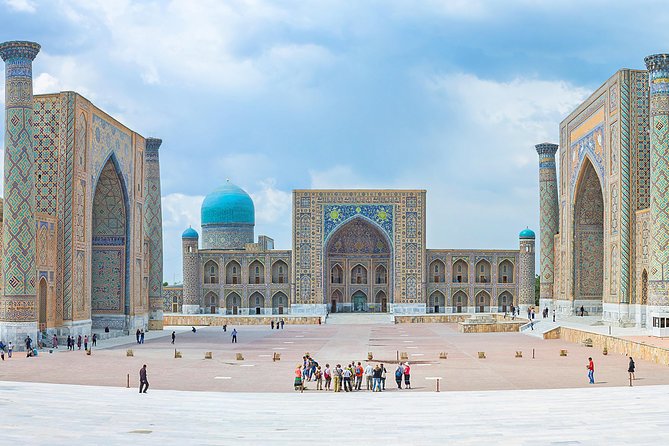
Registan Square is the natural place to begin. It is the city’s best-known gathering place and the point where Samarkand’s architectural drama reaches full volume.
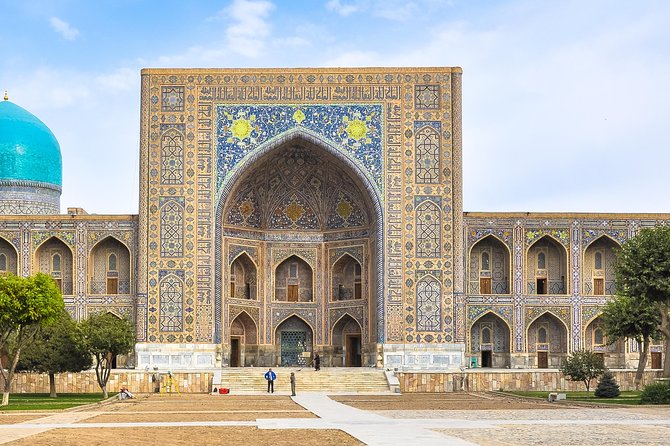
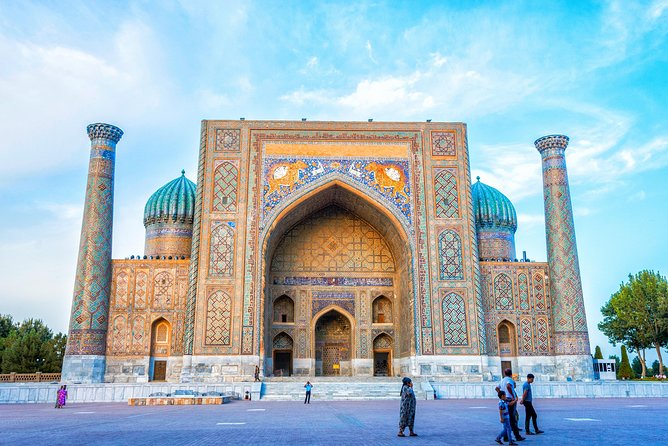
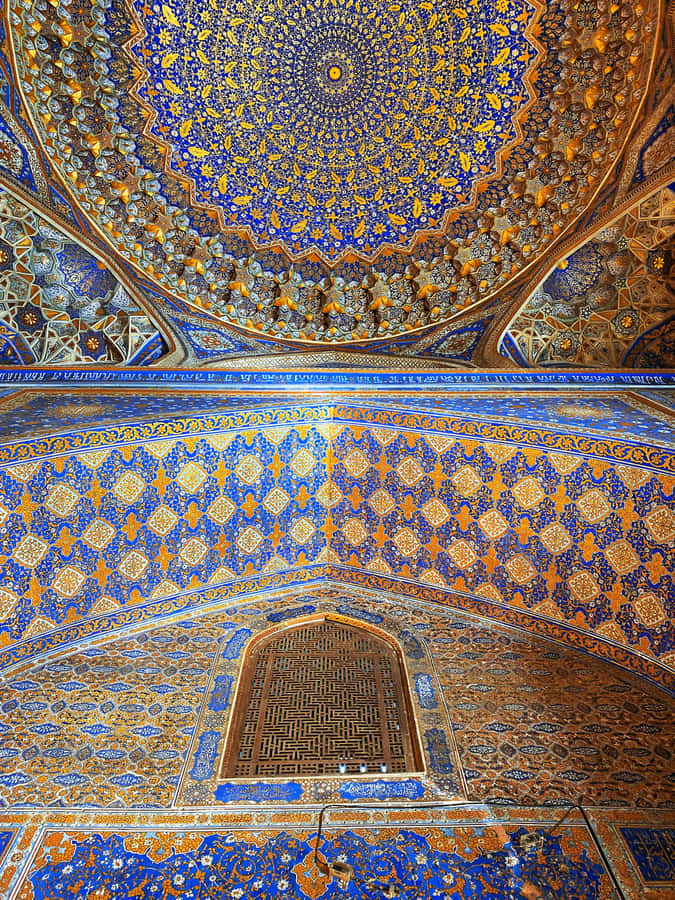
Three madrasahs face the square: Ulugh Beg, Sher-Dor, and Tilya-Kori. Their facades are covered with geometric tile patterns, calligraphy, arches, and bold color. Look up at the domes, then look closer at the smaller details around the entrances. The work is designed to impress from a distance, but it rewards a slower look too.
Your guide will explain the purpose of the buildings and the scholars who studied within them. Ulugh Beg is especially important because its name is tied to learning and astronomy, giving the square an intellectual side beyond its royal appearance.
Sher-Dor has a more unusual visual character, while Tilya-Kori is known for its elaborate decoration. The three buildings are often photographed together, but they are not identical copies. A good guide helps you notice the differences instead of treating the square as one giant postcard.
I would allow extra time here if you can. The tour returns to Registan at the end, giving you a chance to look around again or simply sit and take in the scene. If you are using the tour to orient yourself, this final return is useful. You may have a better sense of which details deserve a second look.
The drawback is that Registan can feel like a lot to absorb at the start. The colors, patterns, history, and scale arrive all at once. Stay close to the guide and save a few visual details for later. You do not need to memorize every ruler to enjoy the square.
Bibi-Khanym Mosque and Timur’s Ambition
From Registan, the tour continues to Bibi-Khanym Mosque, one of the city’s most imposing monuments. It was built by Timur in the 15th century in honor of his wife, and its size reflects the confidence of his rule.
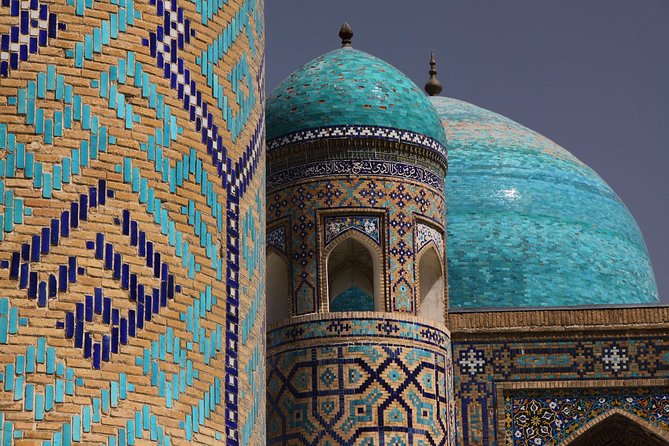
The turquoise domes and mosaics make the mosque instantly recognizable. Here, I would pay attention to proportion as much as decoration. The building was meant to create awe, and its grand scale helps you understand how architecture can serve political power as well as religious purpose.
Your guide can place the mosque within the larger story of Timur’s Samarkand. That context makes the visit more rewarding than a quick stop for photographs. You begin to see the city’s monuments as part of a deliberate effort to make Samarkand a major seat of empire and culture.
Bibi-Khanym also offers a useful contrast with Registan. Registan feels like a formal square designed around several institutions. Bibi-Khanym is more focused and monumental, with the mosque itself carrying the visual weight.
The tour description does not provide a fixed amount of time at each stop, so you should expect the guide to manage the pace. If you enjoy architecture and want to study tilework closely, ask questions early. A small group gives you a better chance of shaping the conversation around what interests you.
Shahi-Zinda: A Narrow Passage of Tile and Memory
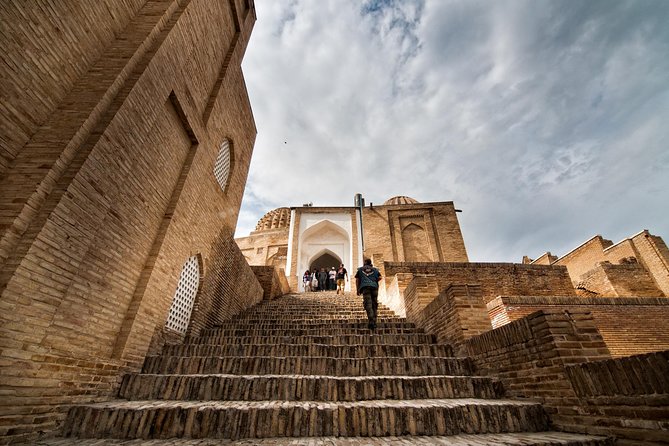
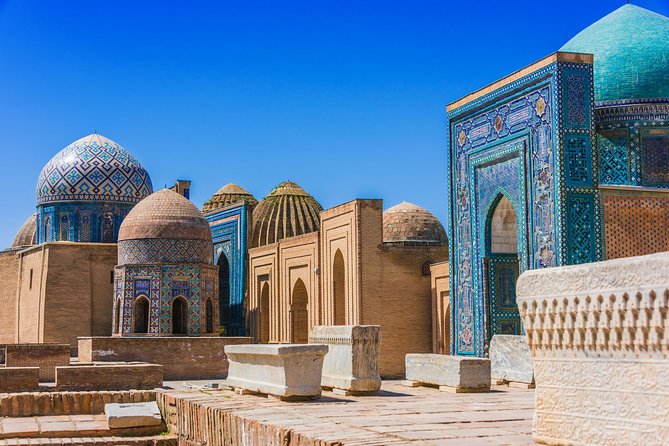
Shahi-Zinda is likely to be the most intimate stop on the route. The complex is formed by mausoleums arranged along narrow alleyways, with decorated facades close to the path.
This change in scale matters. At Registan and Bibi-Khanym, you look across open spaces toward large buildings. At Shahi-Zinda, you move through a tighter passage where tilework surrounds you. The experience becomes less about one huge view and more about examining repeated patterns, color, and the individual character of each tomb.
The complex is a UNESCO World Heritage site, and your guide will explain the stories connected with the mausoleums and the people buried there. Each structure adds another piece to Samarkand’s long religious and civic story.
This is also a place where comfortable footwear matters. The route includes narrow walkways, and the tour is not suitable for wheelchair users. The information provided does not describe every surface or step, so anyone with limited mobility should ask the provider for current details before paying.
Shahi-Zinda can be visually intense. If you rush, the buildings may blur together. I would pause at the thresholds and look at the tile patterns around the entrances. The guide’s anecdotes are particularly useful here because the complex is easier to remember when the people and stories have a place in your mind.
Same stretch of the Silk Road, a different sort of day:
- Samarkand: Historical Monuments Guided Walking Tour
★ 4.8 · 446 reviews - Full Day Private Tour in Seven Lakes from Samarkand
★ 5.0 · 94 reviews - Samarkand One Day Tour: one day walking & group tour
★ 4.4 · 87 reviews - Samarkand: Shahrisabz Day Trip with Optional Local Guide
★ 4.9 · 81 reviews
Gur-Emir Mausoleum and the Timur Connection
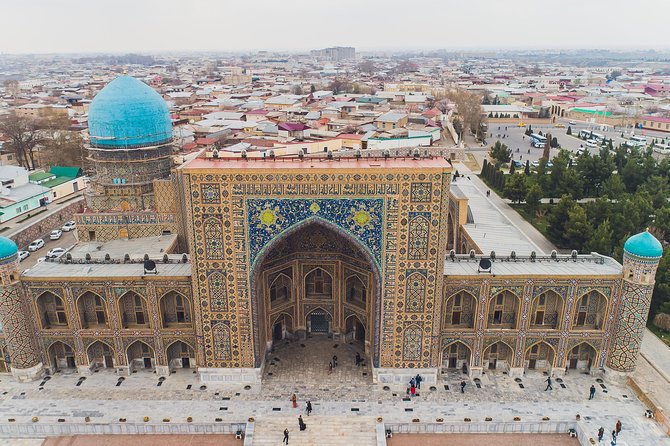
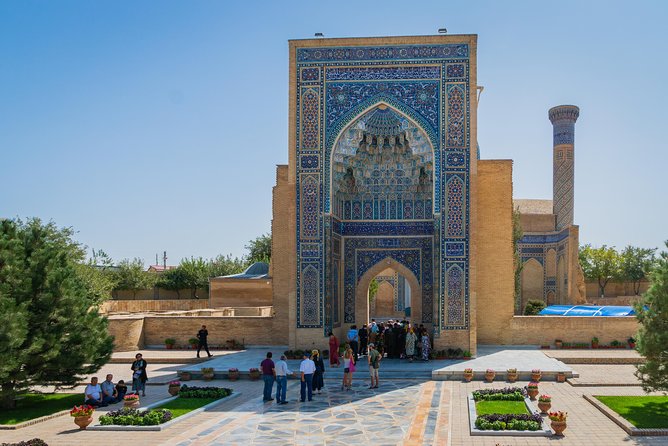
The final major stop is Gur-Emir Mausoleum, the burial place of Timur and his descendants. It brings the tour back to the ruler whose influence appears throughout Samarkand.
Inside, the decoration shifts the mood again. Exquisite tilework and a grand dome create a more enclosed, ceremonial setting than the open spaces at Registan. The visit gives you a chance to consider how Timur’s legacy was preserved through architecture as well as military conquest.
The mausoleum is not just another blue-domed building. It helps tie the day together. You have seen the institutions of learning at Registan, the grand religious project of Bibi-Khanym, the memorial spaces of Shahi-Zinda, and now the dynastic tomb associated with Timur.
Your guide’s explanation is important here. Without context, it is easy to see the dome, take a picture, and move on. With a well-told account, the mausoleum becomes a place for understanding how rulers wanted to be remembered.
The tour ends back at Registan Square. That is a practical finish because you can continue exploring from a central landmark, relax after the guided portion, or return to details you missed earlier.
A Small Group and Guides Who Keep Things Human
The advertised group format is intimate, which is one of the strongest reasons to choose this tour instead of a large organized outing. Small groups usually make it easier to hear the guide, ask follow-up questions, and keep the visit moving without waiting for dozens of people.
The guide quality appears to be the experience’s strongest feature. Amin is praised for his humor as well as his command of the subject. That combination is valuable in Samarkand, where the material can become dense. A few well-timed jokes can make a long sequence of rulers, dates, and architectural terms easier to follow.
Umid is praised for being helpful, kind, and well organized. His assistance at the station is especially useful for visitors who are not sure how to arrange transport after arriving. He also guided a three-and-a-half-hour visit covering three historic sites, which suggests that the tour can work well as a concentrated introduction.
There is one point to clarify before booking: the stated route names four principal stops, while one account describes three historic sites in three and a half hours. This may reflect how the stops were counted, or it may indicate a shorter version of the route. Ask the provider to confirm the exact duration and which landmarks will receive a full visit on your date.
What the $85 Price Really Covers
At $85 per person, this is not a bare sightseeing transfer. The price includes an expert guided tour, transportation to the included landmarks, and a small-group format.
That can be good value if you want one person to connect the monuments and handle the movement between them. Samarkand’s main sights are spread across the city, and transport saves energy that you can use for the sites themselves.
Still, the price is not all-inclusive. Entrance tickets are separate, and meals are not provided. You should compare the total cost with a self-guided day that includes local transport and admission fees.
I would consider the tour a better value for first-time visitors, short-stay visitors, and anyone who wants history explained rather than simply photographed. If you already know Samarkand well and prefer to set your own pace, the cost may feel less attractive.
The reserve-and-pay-later option also gives you flexibility. You can hold a place without paying immediately, then cancel up to 24 hours in advance for a full refund. That is useful when train schedules or wider Uzbekistan plans are still shifting.
Who Will Enjoy This Tour Most
This experience suits you if you want the main Samarkand sights in one organized outing. It is particularly helpful when you have limited time or would rather not arrange transport between monuments.
It also suits history and architecture fans who enjoy asking questions. The guides’ ability to add anecdotes and explain the people behind the buildings is a central part of the value.
You should be comfortable walking through historic sites and narrow passageways. The tour is not suitable for wheelchair users, babies under one year, or people over 95 years. Pets, alcohol, drugs, and explosive substances are not allowed.
The available languages are English and Russian. If you need another language, this tour is not the right match based on the available information.
Practical Tips for a Better Visit
- Wear shoes suited to walking between major monuments and through narrow historic areas.
- Bring a little extra money for entrance tickets, since they are not included in the $85 price.
- Ask about the exact schedule if you want equal time at all four named landmarks.
- If you arrive by train, provide your arrival details clearly. Umid’s station assistance shows that the meeting point can be handled efficiently.
- Stay alert at Registan. The square is large, and it is easy to miss small tile details while focusing on the overall view.
- Save energy for Shahi-Zinda and Gur-Emir. The tour covers several major places in a compact period.
- Take advantage of the return to Registan. It gives you a natural place to continue on your own after the guided portion.
Should You Book the Samarkand City Tour?
I would book this tour if you want a focused introduction to Samarkand with a guide who can make the monuments easier to understand. The strongest points are the small group, transport between the sites, and guides such as Amin and Umid, who bring warmth and useful detail to the visit.
I would hesitate only if you need a slow, highly flexible schedule or want entrance fees included in the headline price. Confirm the exact itinerary and timing first, since the named route includes four major landmarks but one account describes three sites in about three and a half hours.
For most first visits, the tour offers a practical way to meet Samarkand’s essential sights without spending the day sorting out transport and historical context yourself.
FAQ
How much does the Samarkand City Tour cost?
The tour costs $85 per person.
What landmarks are included?
The named stops are Registan Square, Bibi-Khanym Mosque, the Shahi-Zinda complex, and Gur-Emir Mausoleum.
Are attraction entrance tickets included?
No. Entrance tickets are not included in the tour price.
Are meals included?
No. Meals are not included.
Which languages are available?
The tour is available in English and Russian.
Is transportation included?
Yes. Transportation to all included landmarks is provided.
Can I cancel the booking for a full refund?
Yes. You can cancel up to 24 hours in advance for a full refund.
Freshly added in Samarkand
- Uzbek wedding ceremony★ 5.0 · 2 reviews
- Wine tour in Samarkand (Baguizagan) English★ 5.0 · 2 reviews
- Samarkand Capital of Amir Timur Private Tour with Transport★ 5.0 · 3 reviews
- Shakhrisabz Private Day Tour from Samarkand★ 5.0 · 4 reviews
- Seven Lakes Panjakent: One-Day Adventure from Samarkand★ 5.0 · 3 reviews
- The Golden City of Samarkand: A Self-Guided Audio Tour★ 4.0 · 4 reviews
- Tadjikistan 7 Lakes Day Trip from Samarkand with Lunch★ 5.0 · 5 reviews
- Ancient and Modern tour in Samarkand with Transport★ 5.0 · 3 reviews
City Tours, compared.
Khiva: Historical City Highlights Guided Walking Tour
Read our review →
Private Samarkand City Tour With Transportation
Read our review →
A City Tour Of Samarkand: The Pearl Of The East
Read our review →
Tashkent: Private Full-Day City Tour on a Premium Car
Read our review →Browse the lists this tour appears in