
Reviewed · HISTORICAL TOURS
Samarkand: Historical Monuments Guided Walking Tour
Samarkand rewards curious walkers. This five-hour tour links the city’s great monuments with clear historical context, and I like the strong route from Gur-e-Amir to Registan and the lively finish at Siyob Bazaar. The main drawback is the amount of walking, plus entrance fees that add about $21 to the $20 tour price.
I also like that the guides bring more than dates and names to the monuments. Guides such as Gulsanam, Sarvinoz, Shahrizoda, Sevinch, and Sevara are repeatedly praised for patient explanations, good English, local advice, and taking excellent photographs. Still, Samarkand can be hot, and the tour is not suitable for children under six or people with mobility problems.
In This Review
- Key points to know before you book
- Why this route works so well in Samarkand
- Gur-e-Amir: begin with Timur’s royal tomb
- Registan Square: Samarkand’s grand central stage
- Bibi-Khanym Mosque and the cost of ambition
- Siyob Bazaar: a useful break, not just a shopping stop
- Shah-i-Zinda: finish among turquoise mausoleums
- The guides are a major part of the value
- Walking, weather, clothing, and access
- Is the five-hour format good value?
- Who should book this Samarkand walking tour?
- Final verdict: book it for context and coverage
- FAQ
- How long does the Samarkand walking tour last?
- Where does the tour begin?
- Which monuments are included?
- Does the tour finish at Siyob Bazaar?
- Are entrance fees included in the $20 price?
- Is food included?
- What language does the guide speak?
- Is the tour suitable for wheelchair users?
- What should I bring?
Key points to know before you book
- Four essential monuments in five hours: You visit Gur-e-Amir, Registan Square, Bibi-Khanym Mosque, and Shah-i-Zinda in one concentrated route.
- Begin at Gur-e-Amir: The meeting point is the entrance to the mausoleum complex, not your hotel.
- Registan gets the most time: Allow about two hours here, enough for the three madrasahs and plenty of photographs.
- Budget around $41 total: The tour costs $20, while the four listed entrance fees total roughly $21 per person.
- Siyob Bazaar adds a local note: You can shop for dried fruit, nuts, local products, and Samarkand bread before the final monument.
- Expect a serious walk: Comfortable shoes, a hat, and sunscreen are essential. The route includes long periods on foot and several religious sites.
Why this route works so well in Samarkand
Samarkand is not a city you understand from one grand square alone. Its story is spread between royal tombs, religious buildings, schools, markets, and sacred burial grounds. This route gives you the main pieces in a single morning or afternoon, with a guide to connect them.
The order is practical. You begin at Gur-e-Amir, move to the monumental center of Registan, continue to Bibi-Khanym Mosque, stop at Siyob Bazaar, and finish at Shah-i-Zinda. That progression shifts from royal power to education, worship, trade, and spiritual devotion.
You are not simply ticking off famous buildings. You are walking through the different roles Samarkand played along the Silk Road. The guide helps explain why Timur built on such a huge scale, how the Timurid rulers shaped the city, and why certain sites still matter to local people.
The tour is listed at $20 per person, which is a low guiding price for five hours with a live English-speaking guide. Once you add the stated admission fees, the practical total is about $41 per person. That remains a fair deal if you want historical explanation rather than just a route between photo stops.
More History Tours in Samarkand
- Samarkand: Historical Monuments Group Walking Tour
★ 5.0 · 29 reviews - Samarkand Historical City Highlights Guided Walking Tour
★ 5.0 · 22 reviews - Private Guided Tour Samarkand city history and culture
★ 5.0 · 22 reviews
Gur-e-Amir: begin with Timur’s royal tomb
Meet your guide at the entrance to the Gur-e-Amir complex. The first guided visit lasts about 100 minutes, making this more than a quick look at a blue dome.
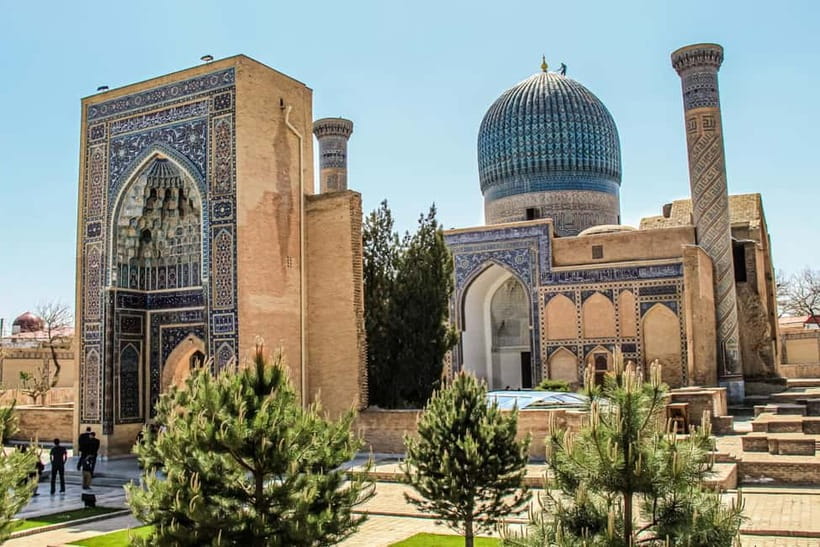
Gur-e-Amir is the mausoleum of Amir Timur, also known as Tamerlane, the powerful ruler associated with the Timurid Empire. The building’s blue-tiled dome and ornate interior give you an early lesson in the design language you will see throughout Samarkand.
I think starting here is smart because the site gives the rest of the tour a historical frame. Before you reach Registan and Bibi-Khanym, you learn about the ruler whose ambition helped transform Samarkand into a major imperial center.
A good guide can make the distinction between admiration and judgment. Timur’s achievements, military campaigns, patronage, and building projects all need room in the story. Guides praised by visitors, including Gulsanam and Sarvinoz, are often singled out for explaining both historical details and the human stories connected to the monuments.
The listed entrance fee is 75,000 UZS, or about $6. Photography is permitted, but flash photography is not allowed inside. Dress modestly, since this is a religious site, and avoid smoking inside the monument.
Registan Square: Samarkand’s grand central stage
Registan receives about two hours, the longest stop on the route. That is exactly right. You need time to look across the square, enter the buildings, study the tilework, and let the scale settle in.
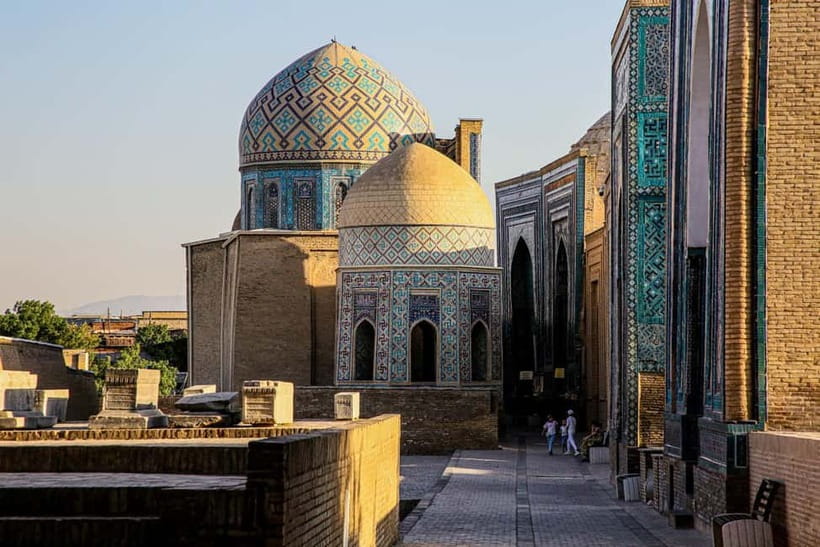
The square is framed by three madrasahs: Ulugh Beg, Sher-Dor, and Tillya-Kori. These religious schools are presented as a unified architectural group, but each has its own details and visual character. Massive domes, patterned façades, mosaics, and carefully restored surfaces make Registan one of Central Asia’s most powerful sights.
Your guide can help you read the decoration instead of seeing it as a wall of blue. Listen for the stories behind the building names, the role of education in the Timurid period, and the way rulers used architecture to express authority. Guides such as Shahrizoda and Sevinch have been praised for balancing facts with stories and for answering questions without rushing the group.
The square is also the place where the route can feel busiest in terms of visual overload. You may want to stop every few steps for another photograph. That is part of the pleasure, but it can make two hours pass quickly.
The entrance fee is listed as 100,000 UZS, about $8.50. Take your time here, since this is the most important stop for many first-time visitors to Samarkand. If you have a camera, plan for wide views as well as close details of the tilework.
Bibi-Khanym Mosque and the cost of ambition
The next monument is Bibi-Khanym Mosque, with about 30 minutes for the visit. Compared with Registan, this is a short stop, but the building’s scale makes a strong impression even in limited time.
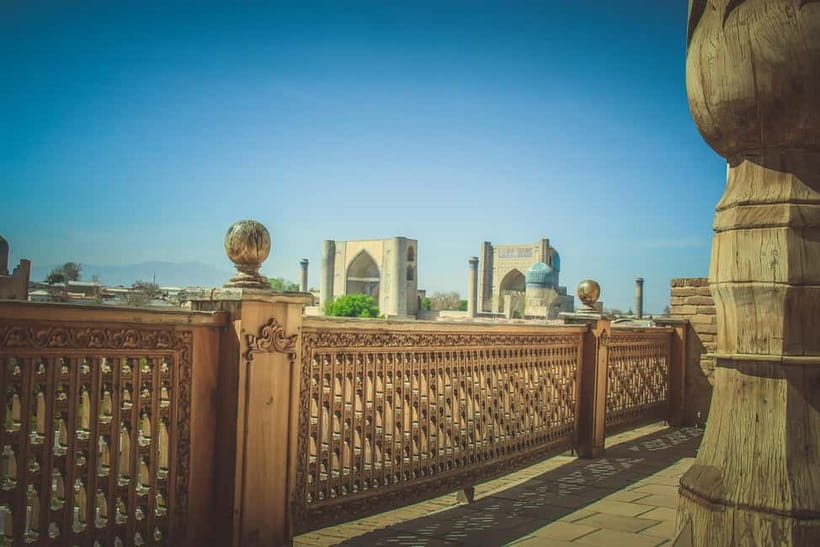
The mosque represents the architectural ambition of Timur’s reign. Its size, decoration, and imposing form were intended to communicate power. The guide also explains the legends surrounding its construction, adding a layer of storytelling to the visible stone and tile.
Thirty minutes is enough for a guided introduction and photographs, but you should not expect the same leisurely examination given at Registan. If you are especially interested in architecture, ask your guide to point out the details that are easiest to miss.
The stated entrance fee is 50,000 UZS, around $3.50. As with the other religious monuments, dress respectfully and do not use flash photography inside. The instructions specifically ask visitors to avoid very short or thin clothing.
More Walking Tours in Samarkand
- Samarkand One Day Tour: one day walking & group tour
★ 4.4 · 87 reviews - Sunset walking tour of Samarkand
★ 4.9 · 16 reviews - Samarkand Walking Tour History Culture and Hidden Gems
★ 5.0 · 9 reviews - Samarkand Walking Tour
★ 4.5 · 8 reviews
Siyob Bazaar: a useful break, not just a shopping stop
After Bibi-Khanym, the tour pauses for about 30 minutes at Siyob Bazaar. This is the oldest and largest market in Samarkand, and it changes the mood completely.
Here, you can see the everyday side of the city. The stop includes time for photographs, shopping, and local treats such as dried fruits and nuts. Samarkand bread, known locally as non, is another item worth looking for. One visitor specifically praised the chance to buy a loaf for 8,000 soms and get help negotiating for souvenirs and local products.
I like this part of the route because it keeps the tour from becoming a procession of monuments. A market gives you a chance to pause, browse, and see what people buy for ordinary life. It also provides a sensible break before the final site.
Thirty minutes is not enough for an unrushed market exploration, so decide what you want before you arrive. If you are buying food, ask the guide about prices and local products. The guide may also offer suggestions for what to eat later, as several highly praised guides are noted for giving useful advice beyond the formal route.
Meals are not included, so anything you sample or purchase at the bazaar is your own expense. Bring cash or a card. The site instructions say both can be used at the destinations, though carrying some local currency is still practical for small purchases.
Shah-i-Zinda: finish among turquoise mausoleums
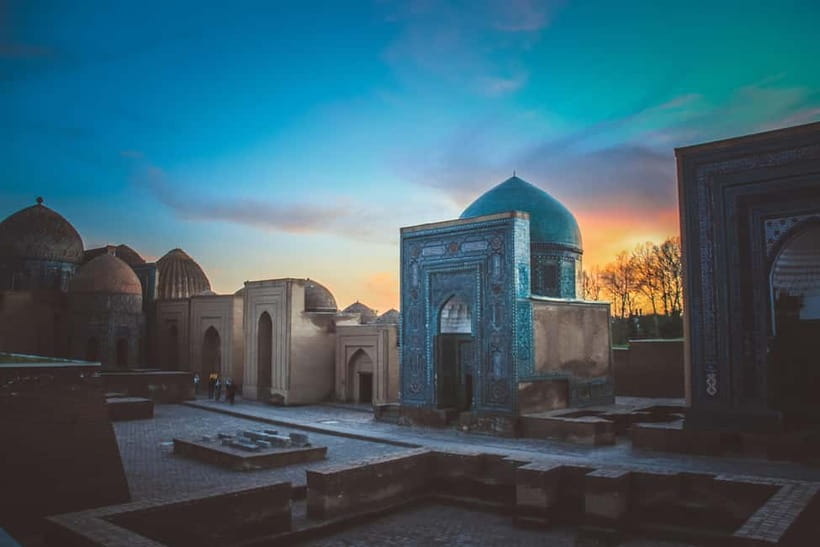
The final stop is Shah-i-Zinda, with about one hour for guided sightseeing and a possible sunset visit. This sacred necropolis is made up of mausoleums from different periods, arranged along narrow passageways.
The setting feels more intimate than Registan. Instead of one enormous open square, you move through a sequence of tiled façades, turquoise surfaces, patterned mosaics, and decorated tomb buildings. Every turn offers another close view of craftsmanship.
Shah-i-Zinda also asks for a quieter kind of attention. It is a religious place with real spiritual meaning, not merely a backdrop for photographs. Your guide can explain the site’s traditions and help you understand how the buildings developed over time.
The listed entrance fee is 50,000 UZS, about $3.50. The route may finish around sunset, which can bring softer light to the tilework, but the exact starting time depends on availability. If you want this final stop in evening light, check the schedule before booking.
The main practical issue is walking. Narrow lanes and the length of the day can be tiring, especially after four earlier monuments. Take the breaks offered, drink water, and do not treat the five-hour duration as five hours of easy strolling.
The guides are a major part of the value
The strongest feature of this experience is not only the monuments. It is the guide. A building can be beautiful and still feel distant if nobody explains what you are seeing.
The most frequently praised guides include Gulsanam, also called Gulli, Sarvinoz, Shahrizoda, Sevinch, Sevara, Shah, Charos, Zulfina, and Amira. Names may vary according to the date and group, so you cannot choose a particular person with certainty unless the provider confirms it.
What you can reasonably expect from the guide team is an English-language explanation of history, architecture, religion, and local culture. The strongest feedback describes patient answers, clear storytelling, thoughtful pacing, and an ability to connect historical facts with modern life in Uzbekistan.
Several people were especially pleased when the guide adjusted the pace or schedule. One small group arriving late in Samarkand received help with timing, while another group appreciated stops for rest and photographs. A solo participant found that the tour became almost private, with time for conversations about life in Samarkand.
Photography help is another repeated strength. Guides such as Gulsanam, Sarvinoz, and Shahrizoda are praised for knowing good angles and taking pictures. That is a pleasant extra, but I would treat it as a bonus rather than a guaranteed photography service.
Walking, weather, clothing, and access
This is a walking tour in the real sense. The monuments are spread across the city, and one direct comment warns that you will walk quite a bit, even though there are enough breaks.
Wear comfortable walking shoes. Add a hat and sunscreen in sunny weather, and carry water. A cold or rainy day is possible too, and one solo participant still found the guide professional and caring in poor weather, but sensible clothing will make a big difference.
The information is inconsistent about wheelchair access. One section labels the activity wheelchair accessible, while the important notes say it is not suitable for wheelchair users or people with mobility impairments. Since the route involves substantial walking and religious sites with narrow passages, I would contact the provider before paying if access is a concern.
Children under six are not recommended. The pace, historical explanations, and amount of walking are better suited to older children and adults who can manage a full half-day on foot.
Dress modestly at every monument. These are religious sites, so avoid very short or thin clothing, follow instructions from the guide, and remember that smoking is not allowed inside. Drones, alcohol, and drugs are prohibited.
Is the five-hour format good value?
For a first visit, yes. The tour covers the four major monuments most people want to see, adds a market stop, and gives you an English-speaking guide for five hours. At $20 before admissions, the guiding cost is modest.
The total listed admission fees are:
- Gur-e-Amir: 75,000 UZS, about $6
- Registan Square: 100,000 UZS, about $8.50
- Bibi-Khanym Mosque: 50,000 UZS, about $3.50
- Shah-i-Zinda: 50,000 UZS, about $3.50
That brings the admissions to about $21, for an estimated total of $41 per person before food and shopping. Prices can change, so treat the dollar figures as a guide rather than a promise.
You are paying for orientation, interpretation, and efficient sightseeing. If you already know Timurid history and prefer to wander alone, you may find the guide less necessary. If you want the buildings to make sense, the cost is easy to justify.
The tour does not include hotel pickup, drop-off, lunch, meals, or personal purchases. You meet at Gur-e-Amir, so plan your own way to the entrance. A private group is available, which may be worth considering if your party wants a slower pace or more time for questions.
Who should book this Samarkand walking tour?
I would recommend it for first-time visitors with limited time in Samarkand, history fans, architecture lovers, and anyone who wants local explanations instead of a silent walk between famous sights. It also suits solo visitors, since a small group can sometimes become a more personal experience.
You should think twice if you dislike long walks, need step-free access, want a relaxed market visit, or prefer to spend an entire afternoon at one monument. The schedule is full, and the four admission fees are extra.
The tour also works well near the start of your stay. A guide can give you useful ideas about food, markets, photographs, and places to explore later. The final stop at Siyob Bazaar makes it easy to continue your own Samarkand wanderings afterward.
Final verdict: book it for context and coverage
Book this tour if you want Samarkand’s major sights explained in one efficient half-day. The route is strong, the price is fair even after entrance fees, and the guides are widely praised for warm personalities, clear English, patient answers, and helpful photographs.
Skip it if you need a low-effort outing or guaranteed wheelchair suitability. For everyone else, this is a practical introduction to Samarkand, with enough time at Registan and a welcome taste of daily life at Siyob Bazaar.
FAQ
How long does the Samarkand walking tour last?
The tour lasts five hours.
Where does the tour begin?
You meet your guide at the entrance of the Gur-e-Amir complex.
Which monuments are included?
The route includes Gur-e-Amir Mausoleum, Registan Square, Bibi-Khanym Mosque, and the Shah-i-Zinda necropolis.
Does the tour finish at Siyob Bazaar?
The route includes a 30-minute break, photo stop, and shopping visit at Siyob Bazaar before continuing to Shah-i-Zinda for the final stop.
Are entrance fees included in the $20 price?
No. Entrance fees are separate. The listed prices are 75,000 UZS for Gur-e-Amir, 100,000 UZS for Registan, 50,000 UZS for Bibi-Khanym, and 50,000 UZS for Shah-i-Zinda.
Is food included?
No. Meals, lunch, and personal expenses are not included. You can buy local treats such as dried fruit, nuts, and Samarkand bread at Siyob Bazaar.
What language does the guide speak?
The live tour guide language is English.
Is the tour suitable for wheelchair users?
The information is conflicting. One section labels it wheelchair accessible, but the important notes say it is not suitable for wheelchair users or people with mobility impairments. Contact the provider before booking if this applies to you.
What should I bring?
Bring comfortable walking shoes, a hat, and sunscreen. Photography is allowed, but flash photography is not permitted inside the monuments.
Freshly added in Samarkand
- Uzbek wedding ceremony★ 5.0 · 2 reviews
- Wine tour in Samarkand (Baguizagan) English★ 5.0 · 2 reviews
- Samarkand Capital of Amir Timur Private Tour with Transport★ 5.0 · 3 reviews
- Shakhrisabz Private Day Tour from Samarkand★ 5.0 · 4 reviews
- Seven Lakes Panjakent: One-Day Adventure from Samarkand★ 5.0 · 3 reviews
- The Golden City of Samarkand: A Self-Guided Audio Tour★ 4.0 · 4 reviews
- Tadjikistan 7 Lakes Day Trip from Samarkand with Lunch★ 5.0 · 5 reviews
- Ancient and Modern tour in Samarkand with Transport★ 5.0 · 3 reviews
Historical Tours, compared.
Khiva: Historical City Highlights Guided Walking Tour
Read our review →
Khiva Historical City Highlights Guided Walking Tour
Read our review →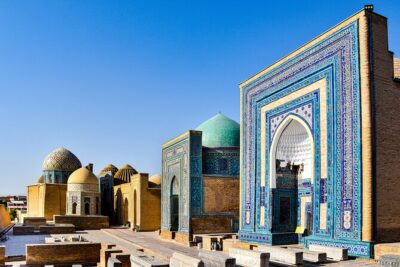
Samarkand: Historical Monuments Group Walking Tour
Read our review →
Samarkand Historical City Highlights Guided Walking Tour
Read our review →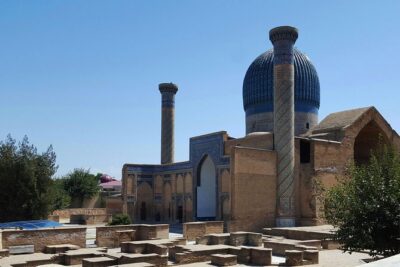
Private Guided Tour Samarkand city history and culture
Read our review →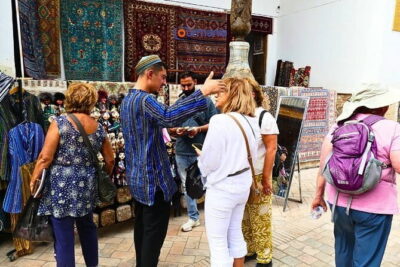
Bukhara Historical City Highlights Guided Walking Tour
Read our review →
Samarkand Walking Tour History Culture and Hidden Gems
Read our review →
Bukhara in a Day History, Culture, and Local Insight Private Tour
Read our review →Browse the lists this tour appears in