
Reviewed · HISTORICAL TOURS
Samarkand: Historical Monuments Group Walking Tour
Samarkand rewards a well-planned first look. This $12 historical monuments tour links the city’s major sights with an English-speaking guide, giving you a useful route through mausoleums, mosques, and madrasas in about four hours and 15 minutes. I especially like the strong lineup, from the blue-tiled Registan to the intimate lanes of Shah-i-Zinda, and the chance to hear the stories behind each place rather than simply snap photos and move on. The main consideration is the tour format: it is described as a group walking tour, yet the details also mention a private, air-conditioned car, so you should confirm the transport arrangement before booking.
I also like that the tour ends at Shah-i-Zinda instead of circling back to its starting point. That makes practical sense if you want to continue toward Samarkand’s eastern sights. Guides named in past bookings include Zarshed and Zarnigor, both praised for clear explanations and a friendly manner. Since entrance fees are separate and the Bibi Khanym details are not perfectly consistent, budget a little extra and ask what is included.
In This Review
- What makes this Samarkand tour worth considering
- Why this route works for a first day in Samarkand
- Gur-i Amir sets the historical tone
- Registan deserves the longest pause
- Bibi Khanym reveals Timur’s ambition
- Hazrat Khizr adds a different layer of history
- Shah-i-Zinda is a strong finish
- What the guide adds to the experience
- Walking, driving, and the practical details
- Who will get the most from the $12 price
- Should you book it?
- FAQ
- How long does the Samarkand historical monuments tour last?
- What monuments are included in the route?
- Where does the tour begin?
- Where does the tour end?
- Is the entrance fee included in the $12 price?
- Is transportation provided during the tour?
- What language does the guide speak?
- What is the cancellation policy?
What makes this Samarkand tour worth considering
- Five major monuments in just over four hours: You see Gur-i Amir, Registan, Bibi Khanym, Hazrat Khizr, and Shah-i-Zinda in one focused outing.
- Registan receives the most time: The 90-minute visit gives you room to examine the Ulugbek, Sherdor, and Tilla-Kari madrasas.
- A guide adds the missing context: Stories about Amir Timur, Ulugbek, Kusam ibn Abbas, and Samarkand’s religious life give the monuments meaning.
- The $12 price is unusually low: The guide and walking tour are included, while monument admission costs extra.
- The route finishes at Shah-i-Zinda: You do not need to return to Gur-i Amir after seeing the eastern end of the city.
- Small details may vary: The activity allows up to 25 people, but the transport description suggests a private car, so clarify the exact setup.
Why this route works for a first day in Samarkand
Samarkand is not a city where the grand sights appear one after another along a single tidy street. Its monuments are spread across different parts of town, and the scale can make a first visit feel less simple than the map suggests. This route solves that problem by tying the main landmarks together in a sensible order.
You begin at Gur-i Amir, continue to the Registan, then visit Bibi Khanym and Hazrat Khizr before finishing at Shah-i-Zinda. That progression also gives you a good introduction to the city’s changing character. You start with a dynastic tomb, move to the great public square, then see a famous mosque and a historic hilltop mosque before ending at one of Samarkand’s most atmospheric memorial complexes.
I would consider this especially useful if you have only one or two days in the city. The tour gives you a firm outline of Samarkand, after which you can return to the places that caught your attention. If you already know the city well, the fixed route and group format may feel less flexible.
The activity is advertised at $12 per person, with group discounts available. That is a very modest price for a guide-led introduction to five major monuments. The catch is the extra admission cost, listed at $6 per person. Add that to the tour price when comparing it with other options. Lunch is described as being arranged along the way, but it is not clearly listed among the included features, so ask if you will pay for it separately.
More History Tours in Samarkand
- Samarkand: Historical Monuments Guided Walking Tour
★ 4.8 · 446 reviews - Private Guided Tour Samarkand city history and culture
★ 5.0 · 22 reviews - Samarkand Historical City Highlights Guided Walking Tour
★ 5.0 · 22 reviews
Gur-i Amir sets the historical tone
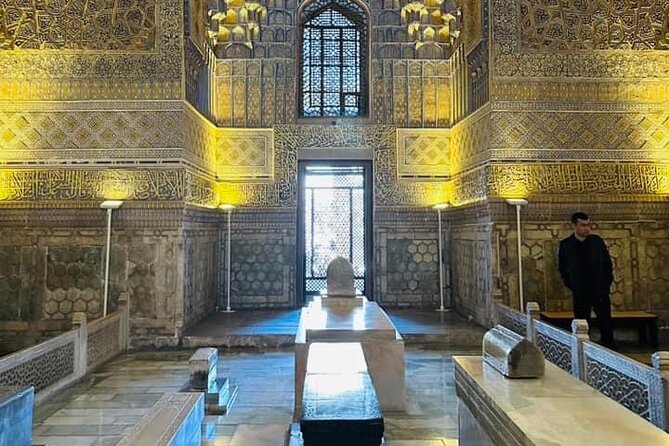
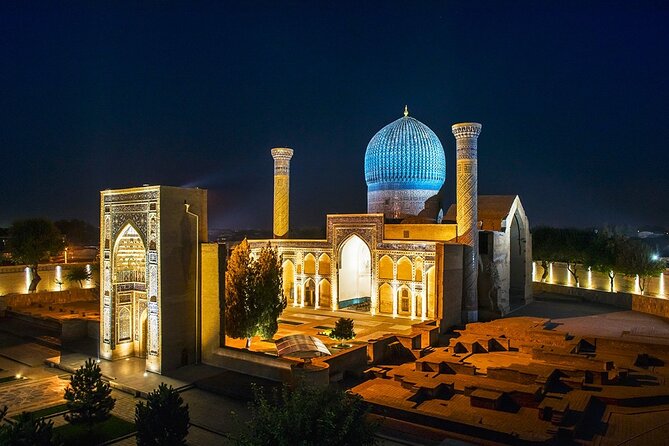
The first stop lasts about 50 minutes at the Gur-i Amir Mausoleum, also called the Amir Temur Mausoleum. This is the burial place of Amir Timur, along with his beloved grandson Muhammad Sultan, the scholar-ruler Ulugbek, and other members of the family.
A guide is valuable here because the building is more than a handsome blue-domed tomb. The tour focuses on its architectural solutions and on Timur’s life, family, ambitions, and fate. Those stories help you understand why Samarkand became the center of such a powerful empire and why dynastic memory mattered so much.
The visit is short enough to keep the morning moving, but long enough for an explanation of the mausoleum’s design. I would use this first stop to get your historical bearings. Names such as Timur and Ulugbek can blur together when you first arrive, and a good guide can separate the ruler, the military leader, and the astronomer in a way that makes the rest of the tour easier to follow.
Admission is not included. The information provided for the tour lists a $6 total monument fee, but also lists individual admission lines, so confirm the current breakdown when you book. The tour begins at the Gur-i Amir complex on Oqsaroy 1, near Universitetskiy Boulevard.
Registan deserves the longest pause
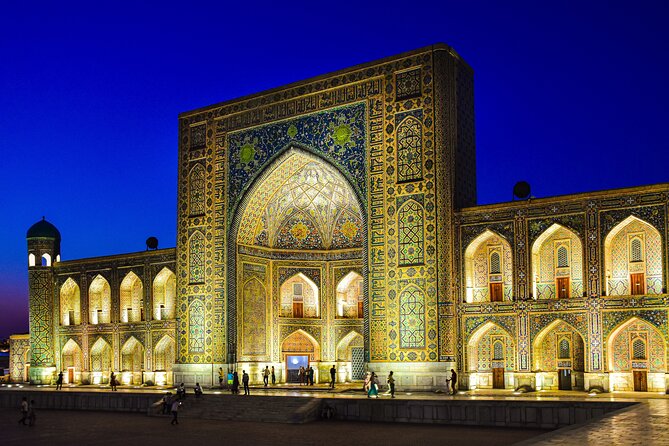
The Registan is the centerpiece of the outing, with about 90 minutes set aside for the square and its three madrasas. That is the right call. If you rush through Samarkand, this is the place you are most likely to regret not seeing properly.
From the 15th to the 17th centuries, Registan served as an educational and spiritual center. Your guide introduces the Ulugbek, Sherdor, and Tilla-Kari madrasas and explains how the buildings relate to one another. The value here is not just identifying each facade. It is learning how the square functioned as a place of study, worship, ceremony, and public life.
I like the generous timing at this stop. You should have enough space to study the tilework, compare the three facades, and ask questions. The guide is also expected to explain the special design features of the madrasas, including the visual tricks and decorative choices that make the square feel larger and more theatrical than a simple open plaza.
Registan admission is not included, and this is one of the places where you should have your entrance money ready. Since the tour is limited to a maximum of 25 people, the group should be manageable, though the experience will naturally feel different with 25 people than with two or three. If you want quiet photographs or long stops at individual details, a private tour may suit you better.
Still, for a first visit, I think the group format offers good value. You are paying a small amount for a guide who can give structure to a place that otherwise risks becoming a grand but confusing wall of blue tile.
Bibi Khanym reveals Timur’s ambition
The Bibi Khanym Mosque receives about 30 minutes. The tour focuses on Amir Timur’s dream of building the finest mosque in the world, along with the legends connected to the project.
This stop is useful because it shifts the story from Timur’s burial place to his public ambition. Gur-i Amir shows dynastic power in a personal setting. Bibi Khanym shows that same ambition on a vast religious scale. The guide’s stories help you connect the two.
The supplied details say the mosque will be viewed from outside and describe admission as free in the stop-by-stop schedule. Elsewhere, Bibi Khanym appears among the sites with admission listed separately. That is an important point to clarify before you arrive. You may be visiting the exterior only, or access arrangements may change.
Thirty minutes is enough for an exterior explanation and photographs, but not for a slow architectural study. I would treat this as a focused stop rather than a full visit. If the mosque is one of your main interests, ask in advance how much access the tour provides and whether any fee applies.
More Walking Tours in Samarkand
- Samarkand One Day Tour: one day walking & group tour
★ 4.4 · 87 reviews - Sunset walking tour of Samarkand
★ 4.9 · 16 reviews - Samarkand Walking Tour History Culture and Hidden Gems
★ 5.0 · 9 reviews - Samarkand Walking Tour
★ 4.5 · 8 reviews
Hazrat Khizr adds a different layer of history
Hazrat Khizr Mosque takes another 30 minutes. The present mosque was reconstructed in the 19th century after the earlier structure was destroyed in the 13th century. The original mosque on this site dates to the 8th century, giving the location a long religious past even though the building you see today is much later.
This is a helpful counterpoint to the more famous monuments. Samarkand’s story is not limited to Timurid architecture. Sites such as Hazrat Khizr show how religious places can be rebuilt, altered, and remembered across many centuries.
The stop is listed with an admission fee, so keep the extra cost in mind. The provided information does not give a detailed breakdown of the interior visit, so your experience may depend on access at the time of the tour. The guide’s role here is particularly important, since the site’s earlier layers are not always obvious from the current structure.
I would also expect this stop to feel less grand than Registan or Bibi Khanym. That is part of its appeal. You get a more focused conversation about continuity, destruction, and reconstruction instead of another enormous facade.
Shah-i-Zinda is a strong finish
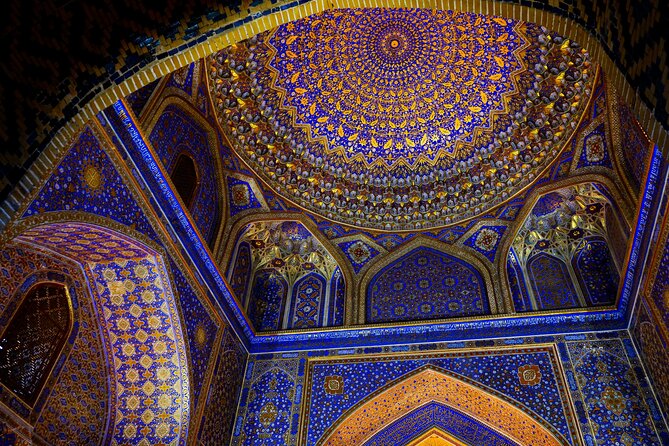
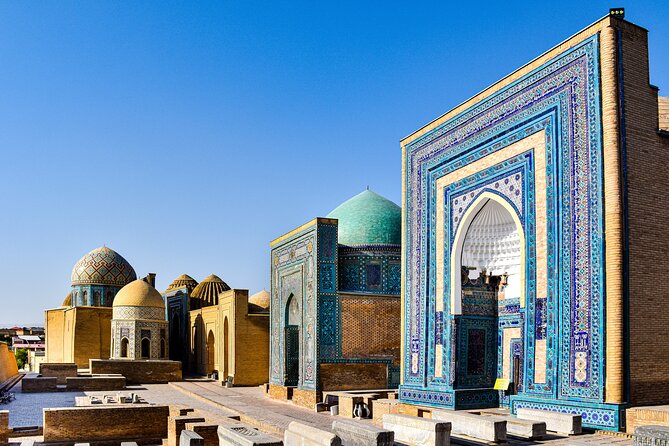
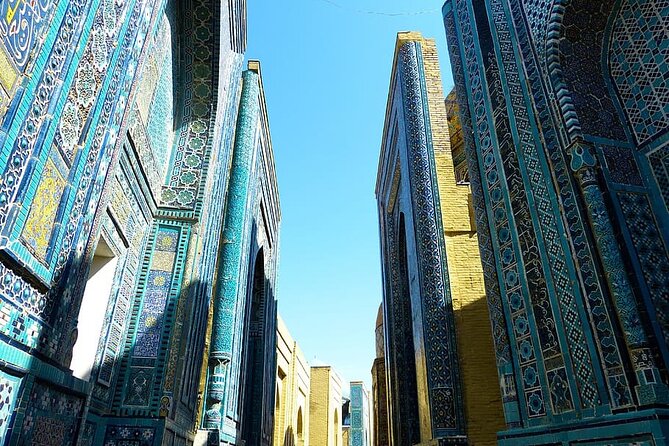
The final stop is Shah-i-Zinda, with about 45 minutes at the memorial complex. It is often considered one of Samarkand’s most mysterious architectural sites, and the route’s final position works well. The tour ends at Shohi Zinda Street rather than returning to the starting point, leaving you in a part of the city that deserves more time if your schedule allows.
The complex is linked to the grave of Kusam ibn Abbas, an associate of the Prophet Muhammad. The guide explains the religious story behind the site and the meaning attached to its many mausoleums. That context matters because Shah-i-Zinda is not simply a procession of decorated tombs. It is a place where architecture, devotion, burial customs, and legend meet.
Forty-five minutes gives you a useful first look, though I would not expect to absorb every detail in that time. The complex can reward slow observation, and the route may feel brisk if your group pauses often for photographs. Admission is not included.
If you are staying in Samarkand, note the ending location carefully. The tour does not return you to Gur-i Amir according to the stated meeting points. That can be convenient if you want to continue exploring, but it means you should plan your next move from Shah-i-Zinda.
What the guide adds to the experience
The strongest reason to book a guided route is the human explanation. The buildings are impressive on their own, but their importance is not always clear from the tilework. You need someone to connect Timur’s ambitions, Ulugbek’s family story, the madrasas’ educational role, and the religious meaning of Shah-i-Zinda.
Zarshed has been praised for explaining Samarkand, Uzbekistan, and Central Asia in a clear and educational way. He has also been described as punctual with hotel pickup and helpful with photographs, which can matter if you are traveling alone. Zarnigor has been praised for being engaging and well informed, and an Italian-speaking guide has also led the route.
Those details suggest that guide quality is a major part of what you are buying. I would confirm your guide’s language when booking, especially if English is not your first choice. The tour information specifically includes a professional English guide, but the presence of an Italian-speaking guide on one booking does not guarantee that language on every departure.
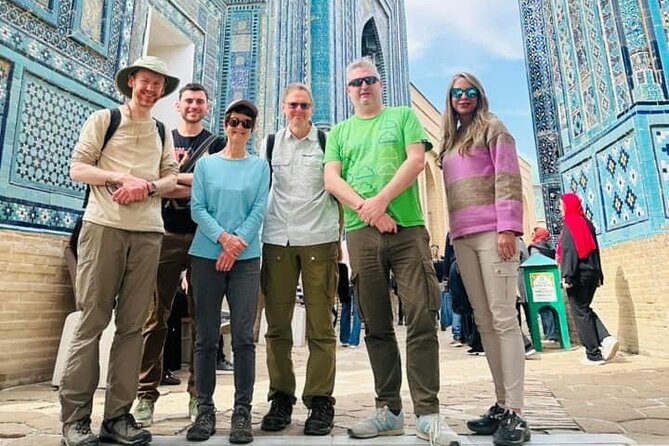
The group can reach 25 people. That is not a tiny walking party, so stand close enough to hear and keep track of the guide when moving between monuments. On the other hand, a larger group can keep the cost low, which is the main reason this tour offers such good value.
Walking, driving, and the practical details
The experience is titled as a group walking tour, and walking is clearly part of the included service. At the same time, the description says you will be driven in a private, air-conditioned car between locations. Those two details do not fully match.
I would ask one direct question before booking: how much of the route is walked, and how much is covered by car? This matters for your footwear, comfort, and expectations. If the car is used between monuments, the route may be easier for people who prefer not to cover long distances on foot. If the activity is mainly walking, comfortable shoes and water become more important.
The total duration is about four hours and 15 minutes. The listed stop times add up to three hours and 35 minutes, leaving roughly 40 minutes for transfers, meeting arrangements, and transitions. That seems reasonable for a route spread across the city.
A mobile ticket is available, and confirmation is sent at booking. Most people can take part according to the activity information. The tour starts at Gur-i Amir and ends at Shah-i-Zinda, so do not assume hotel return unless the operator confirms it.
Lunch is described as arranged while traveling between sites. Since lunch is not listed under the included features, ask whether it is part of the $12 price or an optional purchase. That small check can prevent an awkward pause when the meal is arranged.
Who will get the most from the $12 price
I would recommend this tour most strongly to first-time visitors, short-stay visitors, solo visitors, and anyone who wants the major monuments explained in one outing. It also suits you if you value a guide’s stories more than a completely private schedule.
Solo visitors may appreciate the social setting and the practical help of a guide, including assistance with photos. People with only a day or two in Samarkand can use the tour as a smart orientation, then spend their free time revisiting the places they liked most.
The tour is less ideal if you want to linger for hours at one monument, avoid all group movement, or receive a fully customized route. The maximum group size is 25, and the schedule gives each site a fixed amount of time. Registan gets a generous 90 minutes, but the shorter stops are designed for an overview.
The cancellation terms are fair: you can cancel for a full refund up to 24 hours before the start time. Changes or cancellations inside that window are not accepted for a refund.
Should you book it?
Book this Samarkand tour if you want a low-cost, guide-led introduction to the city’s key monuments and have limited time. The route is well chosen, Registan gets the attention it deserves, and guides such as Zarshed and Zarnigor appear to bring warmth and clarity to the history.
Before paying, confirm three points: the exact transport arrangement, the current entrance fees, and whether lunch costs extra. If those details suit you, $12 is a strong value for a four-hour route through Gur-i Amir, Registan, Bibi Khanym, Hazrat Khizr, and Shah-i-Zinda. If you prefer a slow private visit, book a smaller custom tour instead.
FAQ
How long does the Samarkand historical monuments tour last?
The tour lasts approximately four hours and 15 minutes.
What monuments are included in the route?
The route includes Gur-i Amir Mausoleum, Registan, Bibi Khanym Mosque, Hazrat Khizr Mosque, and Shah-i-Zinda.
Where does the tour begin?
The tour begins at the Amir Temur Mausoleum, also called the Gur-i Amir Complex, at Oqsaroy 1 near Universitetskiy Boulevard in Samarkand.
Where does the tour end?
The tour ends at the Shah-i-Zinda necropolis on Shohi Zinda Street in Samarkand.
Is the entrance fee included in the $12 price?
No. Monument admission is listed separately, with a stated total of $6 per person. The details also say Bibi Khanym is viewed from outside and may be free, so confirm the current fee arrangement before the visit.
Is transportation provided during the tour?
The activity is described as a group walking tour, but it also says transportation is provided in a private, air-conditioned car. Confirm how much of the route is walked and how much is driven.
What language does the guide speak?
A professional English-speaking guide is included. An Italian-speaking guide has also been available on at least one booking, but language availability should be confirmed before booking.
What is the cancellation policy?
You can cancel at least 24 hours before the start time for a full refund. Cancellations or changes made less than 24 hours before the tour are not accepted for a refund.
Freshly added in Samarkand
- Uzbek wedding ceremony★ 5.0 · 2 reviews
- Wine tour in Samarkand (Baguizagan) English★ 5.0 · 2 reviews
- Samarkand Capital of Amir Timur Private Tour with Transport★ 5.0 · 3 reviews
- Shakhrisabz Private Day Tour from Samarkand★ 5.0 · 4 reviews
- Seven Lakes Panjakent: One-Day Adventure from Samarkand★ 5.0 · 3 reviews
- The Golden City of Samarkand: A Self-Guided Audio Tour★ 4.0 · 4 reviews
- Tadjikistan 7 Lakes Day Trip from Samarkand with Lunch★ 5.0 · 5 reviews
- Ancient and Modern tour in Samarkand with Transport★ 5.0 · 3 reviews
Historical Tours, compared.
Samarkand: Historical Monuments Guided Walking Tour
Read our review →Khiva: Historical City Highlights Guided Walking Tour
Read our review →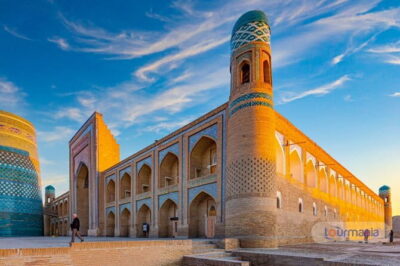
Khiva Historical City Highlights Guided Walking Tour
Read our review →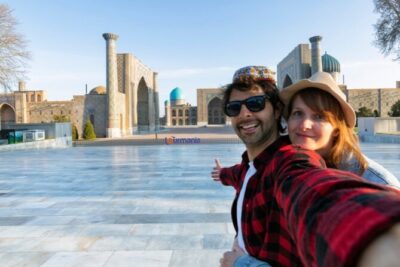
Samarkand Historical City Highlights Guided Walking Tour
Read our review →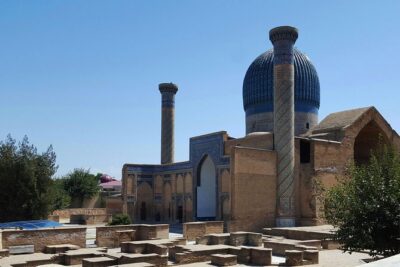
Private Guided Tour Samarkand city history and culture
Read our review →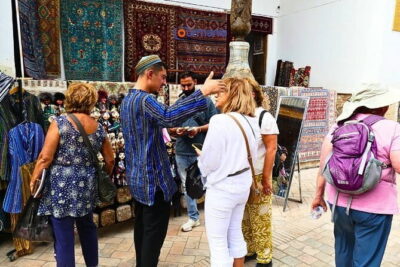
Bukhara Historical City Highlights Guided Walking Tour
Read our review →
Samarkand Walking Tour History Culture and Hidden Gems
Read our review →
Bukhara in a Day History, Culture, and Local Insight Private Tour
Read our review →Browse the lists this tour appears in