
Reviewed · CITY TOURS
Welcome to Tashkent (City Tour with local guide)
Tashkent rewards curious first-timers. This six-hour private-style city tour links the old quarter, grand public squares, colorful Chorsu Bazaar, and the famous Tashkent Metro, giving you a useful first look at Uzbekistan’s capital. I especially like the small group limit of four and the mix of car travel, walking, and metro rides. The English-speaking guide also adds real value, particularly when explaining local customs, food, and the city’s past.
I also like that hotel pickup, an air-conditioned vehicle, bottled water, and Wi-Fi are included. Guides such as Abror have earned praise for being friendly, patient, and helpful, including with a family using a stroller. The main caution is organization: one past booking involved several guide changes, unanswered messages, and a 40-minute delay, so confirm your pickup through WhatsApp after booking.
In This Review
- Five Things to Know Before You Go
- Why This Six-Hour Tour Works for a First Day
- Amir Timur Square and Tashkent’s Central Face
- Theater Square and the Alisher Navoi Opera House
- Independence Square and the Meaning of Public Space
- The Earthquake Memorial and a City Rebuilt
- Khast Imam Square and the Muyi Muborak Library Museum
- Chorsu Bazaar Under the Blue Dome
- Riding the Tashkent Metro
- Plov, the Dish That Completes the Picture
- Guides, Vehicles, and Group Size
- What the Price Includes and What It Does Not
- Who Should Book This Tashkent Tour?
- FAQ
- How long does the Tashkent city tour last?
- What is the maximum group size?
- Is hotel pickup included?
- Which languages are available?
- Is transportation included?
- Is food included in the price?
- Are museum tickets included?
- How much walking is involved?
- Should You Book It?
Five Things to Know Before You Go
- A full six-hour introduction: You cover major sights in both old and new Tashkent without spending the day on foot.
- The metro is part of the sightseeing: The stations are decorated with different themes, ornaments, and lighting, making the train ride more than simple transport.
- Khast Imam includes a major Quran manuscript: The Muyi Muborak Madrasah houses the library museum connected with the original Quran of Othman from the seventh century.
- Chorsu Bazaar brings the city to life: Expect food, textiles, ceramics, carpets, jewelry, fruit, and local trade beneath its large blue dome.
- Plov may be the tastiest finale: The classic Uzbek rice dish is not included in the price, but guides have taken guests to a plov center for a memorable meal.
Why This Six-Hour Tour Works for a First Day
Tashkent is spread out, and its attractions are not all within an easy walk of one another. This tour solves that problem with a car, short walks, and a metro ride. You get a broad introduction without having to work out the city’s transport system on your own.
The route also gives you different versions of Tashkent. The old quarter brings religious buildings, traditional trade, and food culture. The newer central districts show broad avenues, official squares, hotels, theaters, and monuments tied to modern Uzbekistan.
That variety is the tour’s strongest feature. You are not looking at six similar monuments. Instead, you move from a sacred courtyard to a food market, from a memorial to a metro platform, and from Timurid references to Soviet-era urban planning.
The pace should suit most people who want to see a lot in half a day. You will walk about 1.5 kilometers, but the car handles much of the distance between stops. Comfortable shoes still matter because the tour includes standing, market visits, monument stops, and time in metro stations.
The price is $165 for a group of up to four. That works out to $41.25 per person if four people share the vehicle, which is fair for six hours of transport and a private-style guide. For one or two people, the per-person price is much higher, so the value improves sharply when you fill the group.
More City Tours in Tashkent
- Tashkent City Tour
★ 5.0 · 121 reviews - Tashkent city tour
★ 5.0 · 50 reviews - Tashkent: Private Full-Day City Tour on a Premium Car
★ 4.8 · 38 reviews
Amir Timur Square and Tashkent’s Central Face
Amir Timur Square is a logical place to begin understanding central Tashkent. Founded in 1882 as Konstantinovsky Square, it took its current name in 1994 in honor of Amir Timur, the major conqueror and ruler associated with Central Asian history.
The square is surrounded by several important buildings and public landmarks. You can see the Museum of History of the Timurids, the Uzbekistan Hotel, the Forum Palace, and the city’s striking clock. The guide can help connect the square’s older name, its later changes, and the way Amir Timur is presented in modern Uzbekistan.
This is mainly an orientation stop rather than a long museum visit. If you want to enter the Timurids museum, remember that museum tickets are not included. The tour can show you the area and explain its importance, but your time may not allow a detailed museum visit unless the schedule is adjusted.
For me, this stop is useful because it gives you a visual sense of the capital’s central district. It also prepares you for the contrast ahead: broad civic spaces in the newer city and more intimate religious and commercial areas in the old quarter.
Theater Square and the Alisher Navoi Opera House
The State Academic Theater of Uzbekistan, named for the poet Alisher Navoi, was built in 1947. It performs both classical works and national productions and is regarded as one of the country’s leading opera theaters.
You may see the building from outside rather than attend a performance. That is still worthwhile, especially if you appreciate architecture and the cultural role of theaters in former Soviet cities. The stop adds a different note to the itinerary, showing that Tashkent is not only about mosques, bazaars, and monuments.
Ask your guide about the theater’s name and its role in Uzbek culture. The tour is conducted in English, Russian, Uzbek, or Turkish, depending on the guide assigned. A good guide can turn a quick exterior stop into a useful explanation rather than just another photo opportunity.
Independence Square and the Meaning of Public Space
Independence Square is the country’s main civic square. The route presents it as a place connected with Uzbekistan’s past, present, and future, with fountains symbolizing the life energy of the Uzbek people.
The area also includes government buildings, including the Cabinet and Senate, as well as an eternal flame honoring soldiers who died during the Second World War. This is a formal space, so you should expect broad views and official symbolism rather than market life or old architecture.
I find this kind of stop helpful because it provides political and national context. You see how Uzbekistan presents itself in public: independent, orderly, and tied to both national renewal and wartime memory.
Your guide’s explanation matters here. Without context, a large square and fountains can feel like a quick photo stop. With background, the site becomes a way to understand the country’s public identity.
Same stretch of the Silk Road, a different sort of day:
- Best of Tashkent Mountains: Amirsoy, Chimgan & Charvak Trip
★ 4.8 · 567 reviews - Samarkand One Day Tour – Departure From Tashkent
★ 5.0 · 313 reviews - Shymkent Day Tour from Tashkent
★ 4.6 · 71 reviews - Highlights of Tashkent (old and new part)
★ 5.0 · 60 reviews
The Earthquake Memorial and a City Rebuilt
The Earthquake Memorial marks the devastating earthquake that struck Tashkent on April 26, 1966. It was placed near the approximate epicenter, and residents still come to honor the people who helped rebuild the city.
This stop adds emotional weight to the tour. Tashkent’s modern appearance is partly the result of reconstruction after the disaster, and the memorial helps explain why the city has such a mix of older surviving areas and planned modern districts.
The monument is not just a reminder of destruction. It also honors the effort that followed. Your guide can explain how the disaster changed the city and why the memorial remains meaningful to local people.
This is a short visit, but it is one of the stops that gives the city a human story. You are not only looking at buildings. You are learning why some parts of Tashkent look the way they do.
Khast Imam Square and the Muyi Muborak Library Museum
Khast Imam Square is the spiritual center of old Tashkent. Its complex includes the Barakkhan Madrasah, the Kaffal Shashi Mausoleum, and the library of Islamic literature.
The most important stop here is the Muyi Muborak Madrasah, also known as the Moyie Mubarek Library Museum. It is associated with the original Quran of Othman, a seventh-century manuscript regarded as one of the most important Islamic texts in the region.
You are scheduled to spend about an hour here, including time for a guided visit, a break, and photographs. That is generous compared with a quick drive-by, and it gives you time to take in the courtyards, tilework, religious setting, and museum contents.
Dress comfortably and respectfully. The information provided for the tour asks you to bring comfortable clothing, and this is especially relevant at a religious site. Cash is also worth carrying because local payment arrangements and personal purchases may require it.
The square is one of the tour’s essential stops. It connects Uzbekistan’s modern capital with its Islamic scholarship and Central Asian religious traditions. If you want the guide to focus on the manuscript, architecture, or present-day religious life, ask early in the visit so the explanation matches your interests.
Museum admission is not included. The tour includes the guide and transport, but you should budget separately for any museum tickets.
Chorsu Bazaar Under the Blue Dome
Chorsu Bazaar is the old city’s great market. Its name means four waters and refers symbolically to the meeting of four major parts of the old city.
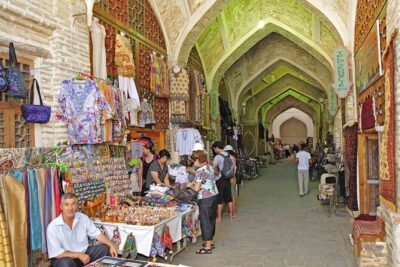
The market’s large blue dome is one of Tashkent’s most familiar sights. It was built in a traditional style after the earthquake and has become a regular feature in postcards and travel photographs. Inside and around the market, you can see ceramics, handicrafts, carpets, jewelry, fabrics, textiles, fruit, and other food products.
This is where you should slow down and use your senses. Look at the colors and shapes, listen to the sellers, and notice how the market functions as both a shopping center and a social meeting place. The tour description also points to food stalls and local ingredients, so ask your guide what is fresh and what is most typical.
The market can be a good place to spend some cash, but personal purchases are not included. Bring local currency. Visa and Mastercard are described as available, but the instructions specifically tell you to have local cash, which is the safer choice.
Food allergies need special care. The provider lists food allergies and lactose intolerance among conditions that may not suit the tour, likely because food and street food can be part of the day. Since lunch, dinner, and street food are excluded, tell your guide about dietary needs before accepting samples or buying food.
Riding the Tashkent Metro
The Tashkent Metro began operating in 1977, and the stations are treated as sights in their own right. Each station has its own thematic decoration, traditional ornaments, and lighting.
This is one of the smartest parts of the route. You get from one part of the city to another while seeing an important piece of local design. The metro also gives you a break from sitting in the vehicle and adds a small taste of how residents move around Tashkent.
The exact stations used are not specified, so you should not expect a fixed set of platforms every time. The guide may choose stations that fit the route and timing. If metro architecture is a major reason you booked, ask which stations are planned at the start of the tour.
The metro ride also makes the day feel less like a standard car circuit. You are not only being driven from monument to monument. You are moving through the city in the same system that has served Tashkent for decades.
Plov, the Dish That Completes the Picture
Plov is Uzbekistan’s classic dish, usually centered on rice and prepared with other ingredients according to local style. It is an important part of the country’s food culture, and the tour highlights it as a key experience.
Lunch is not included, so you should plan to pay for your own meal. One guide, Abror, took a group to a plov center where they described the dish as the best they had eaten in Uzbekistan. That kind of stop can make the tour more personal, but it depends on timing, appetite, and the guide’s plan for the day.
The description also mentions rice, naan, and barbecue as foods the guide may introduce. You can ask for a food recommendation during the bazaar visit or before the tour ends.
Do not assume food is part of the $165 price. It is not. Think of the meal as an optional extra and carry cash for it.
Guides, Vehicles, and Group Size
The tour uses an air-conditioned vehicle for transfers and sightseeing. Several high-rated experiences praised the comfort of the car, the guide’s friendly manner, and the willingness to answer questions about Uzbek culture and history.
Abror is named in several comments as a strong guide, while another family praised his help with a three-year-old’s stroller. The guide name may not always be Abror, though, and the experience is offered in four languages: English, Russian, Uzbek, and Turkish.
A group limit of four is a real advantage. You are more likely to ask questions, adjust the pace slightly, and hear the guide clearly than you would in a large coach group. At the same time, the small group does not guarantee a fixed guide, since one past booking involved three guide changes.
After booking, send a WhatsApp message to the local guide as instructed. On the day, wait in your hotel lobby 10 minutes before pickup. The driver should hold a sign with your last name.
The one clear organizational warning is worth taking seriously. Confirm the time, pickup point, and guide shortly before the tour. This is a simple step that can prevent the sort of missed communication and late arrival reported in one lower-rated account.
What the Price Includes and What It Does Not
At $165 for up to four people, the tour offers its best value to couples traveling with another couple, a family of four, or a small friend group. You receive hotel pickup, transportation, the city tour, a local professional guide, air conditioning, Wi-Fi, and bottled water.
You pay separately for accommodation, lunch, dinner, street food, travel insurance, museum tickets, and personal expenses. The exclusion of meals gives you control over spending, but you should not arrive expecting an included plov lunch.
The tour also offers free cancellation up to 24 hours before the start and a reserve-now, pay-later option. Those terms are useful if your Tashkent schedule may change.
Because the tour lasts six hours, it is a substantial half-day rather than a quick orientation. It works well near the beginning of a longer Uzbekistan visit, when you want someone to explain the city before exploring on your own.
Who Should Book This Tashkent Tour?
I would recommend it to a first-time visitor who wants the main sights in one organized outing. It is especially useful if you have only one day in Tashkent, prefer a small group, or want a guide to handle transport between distant districts.
Families may also find it practical, particularly with a helpful guide and a comfortable vehicle. The 1.5-kilometer walking distance is manageable for many people, but the day still includes standing and movement through public places.
The provider lists the tour as unsuitable for pregnant women, people with heart or respiratory problems, people with high blood pressure, people with recent surgeries, people over 75 or over 95 years, people with altitude sickness, and people with food allergies or lactose intolerance. These restrictions are unusually broad, so check them carefully before booking and contact the provider if your situation is unclear.
I would be more cautious if you want a slow, highly specialized history tour or long museum visits. The route covers many sights, and the tour is designed for broad coverage. One lower-rated experience also found the historical explanations too general, so ask questions if you want more than basic background.
FAQ
How long does the Tashkent city tour last?
The excursion lasts six hours, with the sightseeing portion described as approximately five to six hours.
What is the maximum group size?
The tour is limited to four participants.
Is hotel pickup included?
Yes. Pickup in Tashkent is included. You should wait in the hotel lobby 10 minutes before the scheduled time, and the driver should hold a sign with your last name.
Which languages are available?
The tour is offered with a live guide in English, Russian, Uzbek, or Turkish.
Is transportation included?
Yes. Transfers and city sightseeing use an air-conditioned vehicle. The route also includes a ride on the Tashkent Metro.
Is food included in the price?
No. Lunch, dinner, street food, and personal food purchases are not included. Plov is highlighted as a classic Uzbek dish, but you pay for it separately.
Are museum tickets included?
No. Tickets for museums and other personal admissions are not included.
How much walking is involved?
You will walk about 1.5 kilometers during the excursion. Comfortable shoes are recommended.
Should You Book It?
Book this tour if you want an efficient first look at Tashkent, especially when four people can share the $165 price. The combination of Khast Imam, Chorsu Bazaar, the metro, central squares, the earthquake memorial, and a possible plov stop gives you a useful mix of culture, food, architecture, and city life.
Before paying, send the WhatsApp confirmation message, carry local cash, and ask which guide will lead the tour. If you want a relaxed day with detailed museum study, choose a more specialized private itinerary. If you want to understand Tashkent quickly and comfortably, this is a strong introduction with one practical organizational caution.
Freshly added in Tashkent
- Uzbek Brews & Views: Tashkent Craft Beer Discovery Tour★ 5.0 · 2 reviews
- Uzbekistan Tour – 6 Days 5 Nights★ 5.0 · 4 reviews
- Tashkent International Airport (TAS) to Tashkent – Arrival Private Transfer★ 5.0 · 2 reviews
- 8-Day Private Tour in Uzbekistan with Pick Up★ 5.0 · 2 reviews
- Tashkent-Samarkand-Bukhara tour-3nights/4 days★ 5.0 · 5 reviews
- Tashkent Food and Metro Journey★ 5.0 · 4 reviews
- Private Intercity Transfer Tashkent – Samarkand – Tashkent★ 3.5 · 3 reviews
- Private Tashkent City Tour★ 5.0 · 3 reviews
City Tours, compared.
Khiva: Historical City Highlights Guided Walking Tour
Read our review →
Private Samarkand City Tour With Transportation
Read our review →
A City Tour Of Samarkand: The Pearl Of The East
Read our review →
Tashkent: Private Full-Day City Tour on a Premium Car
Read our review →Browse the lists this tour appears in