
Reviewed · TASHKENT TOURS
Tashkent-Samarkand-Bukhara tour-3nights/4 days
Three cities, one fast-moving Silk Road trip. This private tour gives you a tidy way to see Uzbekistan’s grandest sights, with hotels, breakfast, local transport, entrance tickets, and high-speed trains arranged in advance. I especially like the private format, which keeps the pace and questions in your hands, and the smart use of Afrasiyab trains between the major cities.
The schedule also has real strengths. You get the food and daily life of Tashkent, the old religious center of Bukhara, and Samarkand’s famous blue-tiled monuments. The main drawback is the pace: four days leaves little spare time, and the early departure from Tashkent on Day 2 will test anyone who likes a leisurely breakfast.
In This Review
- Key points to know before booking
- What the $1,200 price really covers
- Day 1: Tashkent’s old quarter, bazaar, and museums
- Day 2: An early train to Bukhara and a royal summer palace
- Day 3: Bukhara’s old center, from Magoki Attori to the Ark
- Day 4: The blue-tiled wonders of Samarkand
- Trains, timing, and the private guide
- Who should book this four-day route?
- Should you book the Tashkent, Samarkand, and Bukhara tour?
- FAQ
- How long is the tour?
- Where does the tour start?
- Where does the tour end?
- Are the high-speed train tickets included?
- Are hotels included?
- Are meals included?
- Is this a private tour?
Key points to know before booking
- A private trip for your own party: You are not folded into a large coach group, so you can ask questions and request Uzbek meal suggestions from your guide.
- Three major Silk Road cities: The route links Tashkent, Bukhara, and Samarkand, each with a different feel and set of monuments.
- Afrasiyab high-speed trains included: Economy tickets cover Tashkent to Bukhara, Bukhara to Samarkand, and Samarkand back to Tashkent.
- Hotels and three breakfasts included: Accommodation is on a twin-sharing basis in Tashkent, Bukhara, and Samarkand.
- A packed final day: Gur Emir, Registan, the observatory, Shah-i-Zinda, and Bibi Khanum all appear before the evening train.
- Strong early response: The experience has a 5 out of 5 rating from five reviews, including praise for the friendly and thoughtful team.
What the $1,200 price really covers
At $1,200 per person, this is not a budget tour. It is a bundled private arrangement, and the value depends on how much you would otherwise spend organizing the moving parts yourself.
The price includes twin-share hotel accommodation, breakfast in all three cities, transport by comfortable car where needed, entrance tickets listed in the program, and three Afrasiyab high-speed train journeys. Taxes are also included. That removes several common headaches in Uzbekistan, especially coordinating rail tickets around a short schedule.
Lunches and dinners are not included. Neither are tips, personal purchases, international flights, hotel extras, early check-in, late checkout, or photography and video fees charged at sights. You should budget for meals separately and confirm exactly which hotel services carry an extra charge.
I see the strongest value in the transport plan. The long intercity legs are handled by train instead of putting you in a car for every kilometer. You also have a private guide and party rather than a fixed large group. If you are comfortable arranging hotels, rail tickets, taxis, and guides on your own, the price may feel high. If you want one company to connect the whole route, it is easier to justify.
The tour is commonly booked about 46 days ahead. That is useful planning advice, especially for a trip built around specific high-speed train departures. The provider is Silk Road Travellers, and confirmation arrives when you book.
Other Tashkent trips travellers line up with this one:
- Best of Tashkent Mountains: Amirsoy, Chimgan & Charvak Trip
★ 4.8 · 567 reviews - Samarkand One Day Tour – Departure From Tashkent
★ 5.0 · 313 reviews - Tashkent City Tour
★ 5.0 · 121 reviews
Day 1: Tashkent’s old quarter, bazaar, and museums
The tour begins at 7:00 a.m. at Hotel Uzbekistan on Mirzamakhmud Musakhanov Street. Pickup can be requested, which helps if you are staying elsewhere in Tashkent and do not want to cross the city before breakfast.
Your first major stop is the Hazrati Imam Ensemble, the religious center of old Tashkent. The complex includes the 16th-century Barak Khan Madrasah and the mausoleum of Kaffal Shashi. Allow about an hour. This is a good opening because it introduces the city through Islamic architecture and scholarship rather than only through its Soviet avenues and modern center.
The buildings deserve time for their tilework and courtyards, but the visit is still short. If you enjoy architectural details, ask your guide to explain how a madrasah functioned and how the different parts of the ensemble relate to one another. The guide is particularly useful here, since the visual details alone do not explain the site’s religious role.
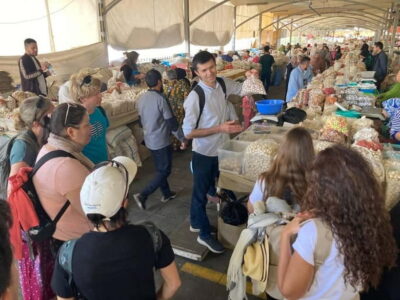
Next comes Chorsu Bazaar, one of Central Asia’s major markets. You have about 40 minutes, enough to see the large market structure and get a sense of local shopping life. This is the place to look beyond monuments: food stalls, produce, spices, and everyday trade show you how Tashkent works as a living city.
Forty minutes is a brisk visit. You will not have time to wander every section or shop at a relaxed pace, so keep purchases simple. The bazaar is also a natural place to ask your guide for advice on authentic Uzbek dishes. Since lunch is not included, that recommendation can be more useful than another formal restaurant stop.
The nearby Kukeldash Madrasah takes about 20 minutes. Built in 1569, it was the largest of the 23 madrasahs in old Tashkent. This is a short, focused stop, best understood as part of the old-city cluster rather than a full separate visit.
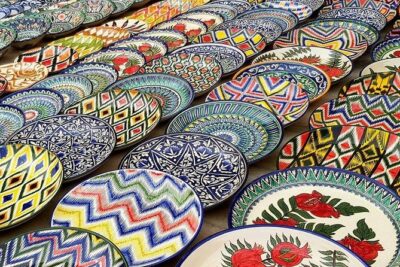
The Uzbekistan State Museum of Applied Art then shifts the focus from monumental buildings to domestic craft. The collection holds more than 4,000 objects showing Uzbek decorative arts, including wood carving. You get around 40 minutes, which should give you a clear introduction to the collection without turning the first day into a museum marathon.
The program also includes central Tashkent stops at a major square used for national events and parades, along with Amir Temur Square. The square is a favorite local meeting place and gives you a change of scale after the old quarter. These stops are more about orientation and city character than detailed sightseeing.
You overnight in Tashkent. Day 1 covers a lot, but the route is coherent: religious buildings, market life, a historic school, decorative arts, and the modern capital. I like that balance. The limitation is that most stops are measured in minutes, so you should expect an introduction rather than a slow study of each place.
Day 2: An early train to Bukhara and a royal summer palace
Day 2 starts early. Breakfast is scheduled around 5:30 to 6:00 a.m., followed by hotel checkout at 6:30. You then take the Afrasiyab high-speed train from Tashkent to Bukhara, a journey listed at about 3 hours and 50 minutes over roughly 600 kilometers.
This is one of the tour’s best practical choices. A train ride lets you rest, watch Uzbekistan pass by, and avoid a full day in a road vehicle. The early start is the price you pay for reaching Bukhara with time left for sightseeing.
After arriving at 11:15, the program turns to the Palace of Moon-like Stars, also called Sitorai Mokhi-Khosa. The visit is planned for three hours, making it one of the more generous blocks in the schedule. The palace offers a different side of Bukhara from its medieval mosques and madrasahs, with a setting connected to the city’s ruling family and later-era court life.
Because the palace visit takes much of the afternoon, you should not expect a long first walk through central Bukhara on this day. That is not necessarily a flaw. The following day is devoted to the historic center, while this stop gives the itinerary some variety.
Hotel details are not specified in the tour information, so I would confirm the property, room setup, and exact location before paying. Twin accommodation is included, but solo guests should ask whether a single supplement applies.
Day 3: Bukhara’s old center, from Magoki Attori to the Ark
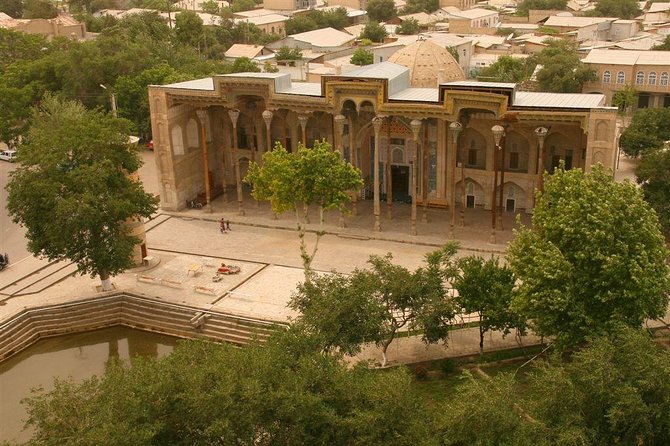
Bukhara gets its proper sightseeing day on Day 3. Begin around Lyab-i-Hauz, a much-loved ensemble built around a historic pool. It is a calm place to pause, and its shaded setting makes a useful break between more formal visits.
The word hauz refers to a pool, and the ensemble’s open space helps you understand how Bukhara’s old center once supported social life as well as worship and commerce. Do not rush through it just to reach the next monument. This is one of the places where simply sitting for a few minutes adds to the visit.
The Magoki Attori Mosque and carpet museum follows, with about 20 minutes allotted. The mosque is a medieval structure in the historic center, and parts of it lie more than 4.5 meters below today’s ground level. That unusual position gives the site a physical sense of Bukhara’s many building layers.
The short timing means you will want the guide to explain what you are seeing before moving on. The carpet museum adds a craft element to the morning, but you should not expect a long, specialist textile visit.
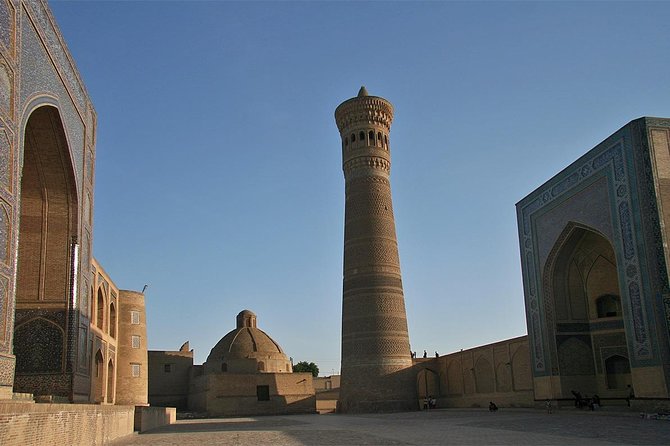
Next is the Poi Kalyan ensemble, centered on the Great Minaret of the Kalon. The complex includes the Kalyan minaret, Kalyan Mosque, and Miri Arab Madrasah, with buildings dating from the 12th to the 16th centuries. You have about 40 minutes here.
This is one of Bukhara’s essential views. The minaret provides the visual anchor, while the surrounding religious buildings make the square feel like a complete architectural setting rather than one isolated monument. Your guide can help separate the different structures and periods, which is helpful when the names begin to blur.
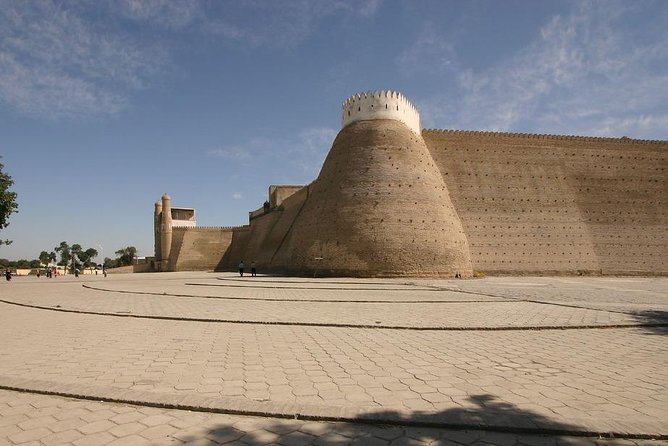
The Ark of Bukhara gets an hour. This ancient citadel rises nearly 20 meters above the surrounding ground and covers about four hectares. Its scale makes clear that Bukhara was not only a place of worship and trade. It was also a seat of government and power.
The Ark can be physically demanding in spots, and the raised position may involve uneven surfaces. The tour information says most people can participate, but it does not provide a detailed mobility assessment, so ask ahead if stairs or walking surfaces are a concern.
At 3:50 p.m., you take the Afrasiyab train to Samarkand, arriving at 5:15. This is a very efficient transfer, though it leaves little room for a relaxed Bukhara lunch or last-minute shopping. Lunch is not included, so plan your meal around the train departure rather than hoping to fit it in at the end.
You overnight in Samarkand. The day gives Bukhara’s core sights a useful, concentrated introduction, but the timetable leaves little slack. If Bukhara is your main reason for visiting Uzbekistan, you may want extra nights beyond this tour.
Same stretch of the Silk Road, a different sort of day:
- Shymkent Day Tour from Tashkent
★ 4.6 · 71 reviews - Highlights of Tashkent (old and new part)
★ 5.0 · 60 reviews - 2 Days Tour to Bukhara and Samarkand from Tashkent by train
★ 5.0 · 53 reviews - Tashkent Airport & Train Station Pick Up & Drop Off
★ 4.5 · 50 reviews
Day 4: The blue-tiled wonders of Samarkand
The final sightseeing day packs in Samarkand’s headline monuments. At Gur Emir, you visit the mausoleum of Tamerlane, his mentor Mir Sayyid Barak, and members of the Timurid family. Give this hour to the interior details as well as the exterior form. The site is central to understanding the Timurid period and Samarkand’s role under Tamerlane.
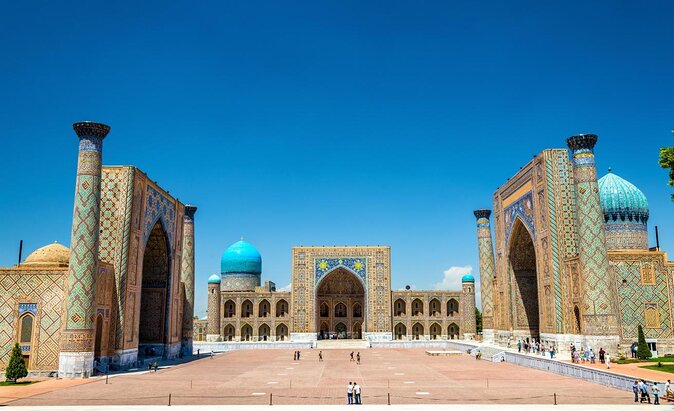
Registan follows for another hour. Its three madrasahs are Ulughbek, built in the 15th century, and Sherdor and Tillakori, built in the 17th century. This is the image most people associate with Samarkand, but it works best when you look closely at the facades, portals, and courtyard arrangement instead of only taking a quick photo.
The itinerary allows one hour, which is fair for a first visit. If you want quiet time for photography, the fixed schedule may feel tight. The private format helps, since you can ask your guide whether a few extra minutes are possible, but the evening train still sets a firm limit.
At the Ulugh Beg Observatory, you spend about 40 minutes. Built in 1424 to 1428 on Kuhak Hill, it represents Samarkand’s scientific side. This stop adds useful balance after the religious and royal monuments. It shows that the city’s intellectual life included astronomy and measurement, not only grand architecture.
Shah-i-Zinda receives an hour. This avenue of mausoleums belonged to Karakhanid and Timurid nobility, and the surviving complex includes eleven mausoleums. The tiled surfaces make it one of Samarkand’s most detailed sites, but the visit may involve stairs and uneven walking.
Bibi Khanum Mosque is also included in the route. Built between 1399 and 1404, it was Tamerlane’s grand cathedral mosque, decorated with tiles, carved marble, and murals. The program does not give a separate duration for this stop, so confirm with your guide how much time is planned.
At 5:30 p.m., you take the Afrasiyab train back to Tashkent. The journey is listed at about 2 hours and 10 minutes, with arrival around 7:40 p.m. The tour ends back at the meeting point. This makes the final day long, but it also means you see a great deal without spending the night in another hotel.
Trains, timing, and the private guide
The train schedule is the backbone of this tour. Afrasiyab tickets cover all three intercity legs, and the high-speed service keeps the route realistic in only four days. Economy tickets are included, so do not expect a premium rail experience, but the main benefit is speed and predictability.
The private format matters most when the schedule gets tight. You can ask for explanations at the monuments, request food advice, and travel only with your own party. The published experience does not name the individual guides, so you cannot select a particular guide in advance.
A past rating of 5 out of 5 from five reviews is encouraging, and the strongest praise focuses on a friendly, thoughtful team. That personal care is important on a trip with early breakfasts, hotel changes, train connections, and many entrance points. Still, five ratings are a small sample, so I would treat the perfect score as a positive signal rather than a guarantee.
The tour offers mobile tickets, pickup on request, and access to public transportation near the meeting point. Service animals are allowed, and most people can participate. Ask specific questions before booking if you need step-free access, extra rest time, or special hotel arrangements.
Who should book this four-day route?
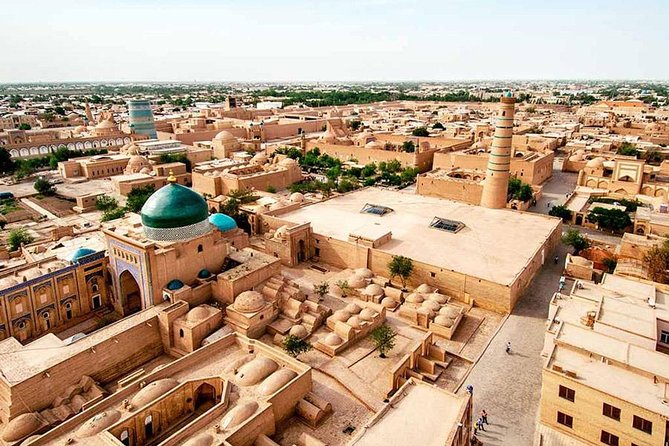
I would recommend it to a first-time visitor who wants the major sights of Uzbekistan without planning every train, transfer, ticket, and hotel. It suits couples, families, and small private parties that value convenience and the ability to ask a guide for help with meals and cultural details.
It is less suitable if you prefer slow mornings, long market visits, or unplanned time in one city. The 5:30 a.m. breakfast on Day 2 and the packed Samarkand finale are serious parts of the decision.
Should you book the Tashkent, Samarkand, and Bukhara tour?
Book it if your priority is seeing all three major cities in four days with the main logistics handled. The trains, private touring, included tickets, hotels, and breakfast give you a clear framework, while the friendly team and food advice add a human touch.
Skip it, or ask for a longer version, if Bukhara or Samarkand deserves more than a quick introduction. At $1,200 per person, the tour earns its price through convenience rather than cheapness. For a short Uzbekistan visit, that trade can be worthwhile. For a slower cultural trip, add nights and reduce the rush.
FAQ
How long is the tour?
The experience lasts approximately four days and includes three overnight stays, in Tashkent, Bukhara, and Samarkand.
Where does the tour start?
It starts at 7:00 a.m. at Hotel Uzbekistan, Mirzamakhmud Musakhanov Street 45, Tashkent. Pickup can also be requested.
Where does the tour end?
The activity ends back at the meeting point in Tashkent after the return train from Samarkand.
Are the high-speed train tickets included?
Yes. Economy Afrasiyab tickets are included for Tashkent to Bukhara, Bukhara to Samarkand, and Samarkand to Tashkent.
Are hotels included?
Yes. Twin-share hotel accommodation is included in Tashkent, Bukhara, and Samarkand.
Are meals included?
Three breakfasts are included. Lunches and dinners are not included.
Is this a private tour?
Yes. Only your own group participates in the activity.
Freshly added in Tashkent
- Uzbek Brews & Views: Tashkent Craft Beer Discovery Tour★ 5.0 · 2 reviews
- Uzbekistan Tour – 6 Days 5 Nights★ 5.0 · 4 reviews
- Tashkent International Airport (TAS) to Tashkent – Arrival Private Transfer★ 5.0 · 2 reviews
- 8-Day Private Tour in Uzbekistan with Pick Up★ 5.0 · 2 reviews
- Tashkent Food and Metro Journey★ 5.0 · 4 reviews
- Private Intercity Transfer Tashkent – Samarkand – Tashkent★ 3.5 · 3 reviews
- Tashkent Mountain Tour Amirsoy with Transport★ 3.5 · 3 reviews
- Private Tashkent City Tour★ 5.0 · 3 reviews
Tashkent Tours, compared.
Best of Tashkent Mountains: Amirsoy, Chimgan & Charvak Trip
Read our review →
Samarkand One Day Tour – Departure From Tashkent
Read our review →
2 Days Tour to Bukhara and Samarkand from Tashkent by train
Read our review →
Browse the lists this tour appears in