
Reviewed · TASHKENT TOURS
Uzbekistan 8 Days Private Tour Tashkent-Urgench-Bukhara-Samarkand-Tashkent
Uzbekistan rewards travelers who keep moving. This private eight-day trip links Khiva, Bukhara, and Samarkand, three of Central Asia’s most important Silk Road cities, with Tashkent at both ends. I like the efficient route and the fact that your guide arranges hotels, transfers, trains, and entrance tickets. I also like the private format, which gives you more control than a large coach tour.
The price is $975 per person, a fair package cost for six hotel nights, city guides, breakfast, domestic transfers, trains, and site admissions. The main catch is the pace. You cover a lot of ground, and the Khiva to Bukhara train can take six hours, while the flight from Tashkent to Urgench costs extra.
In This Review
- Key points before you book
- What the eight-day route really feels like
- Tashkent: Soviet avenues and old-city faith
- Khiva: a complete day inside Itchan Kala
- Bukhara: the strongest Silk Road day
- Bukhara free time and the optional countryside
- Samarkand: big monuments, close together
- Samarkand’s second look and the return to Tashkent
- How good is the $975 value?
- Who should choose this Uzbekistan tour?
- FAQ
- How long is the Uzbekistan private tour?
- Is the Tashkent to Urgench flight included?
- Are hotels included?
- Are train tickets included?
- Are breakfasts included?
- Are entrance tickets included?
- Is this a private group tour?
- Should you book it?
Key points before you book
- Khiva’s walled Itchan Kala: You spend a full sightseeing day inside one of Uzbekistan’s most memorable old cities.
- Bukhara’s Silk Road center: Lyab-i-Hauz, the trading domes, the Ark, and the Kalyan complex fill a strong first day.
- Samarkand’s major monuments: Registan, Gur Emir, Shah-i-Zinda, Bibi Khanym Mosque, and Siab Bazaar are all included.
- Private city guides: Guides are arranged in each city, with named guides including Tulkin in Khiva, Behrus in Bukhara, Jusra in Samarkand, and Nusrat in Tashkent.
- Rail travel included: The Khiva to Bukhara train and high-speed trains between Bukhara, Samarkand, and Tashkent are part of the package, subject to availability.
- Free time built in: You get open periods in Bukhara and Samarkand for rest, independent walks, or optional half-day outings.
What the eight-day route really feels like
This is not a slow, stay-put holiday. It is a compact tour for people who want to see Uzbekistan’s main historic cities in one trip.
You begin in Tashkent, fly west to Urgench, continue by road to Khiva, then take the train to Bukhara. From there, you use the railway again to reach Samarkand before returning to Tashkent by high-speed train. The route is sensible, but each transfer takes time.
I like the private setup because it softens the pressure of this schedule. Your driver meets you at arrivals, takes you to the hotel, and handles city-to-city transfers. You are not trying to decipher every station, airport, or hotel arrival on your own.
The package includes air-conditioned transport, six nights in centrally located three- to four-star or boutique hotels, six breakfasts, licensed guides, entrance fees, and 24-hour customer service. The domestic Tashkent to Urgench flight is not included, with fares listed from $50. You should also allow for guide and driver tips, single-room charges, and small photography fees at some museums.
Other Tashkent trips travellers line up with this one:
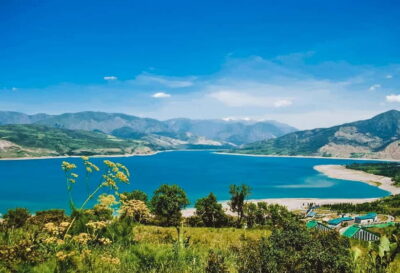
- Best of Tashkent Mountains: Amirsoy, Chimgan & Charvak Trip
★ 4.8 · 567 reviews - Samarkand One Day Tour – Departure From Tashkent
★ 5.0 · 313 reviews - Tashkent City Tour
★ 5.0 · 121 reviews
Tashkent: Soviet avenues and old-city faith
Your first day is mainly an arrival day. A driver meets you at the airport exit with a name sign and transfers you to the hotel. The listed transfer takes about 15 minutes, so you should have time to settle in, depending on your arrival hour.
The sightseeing begins with the Alisher Navoiy Theater, designed by Alexey Shchusev and built between 1942 and 1947. The building was opened in connection with the 500th anniversary of Alisher Navoi’s birth. A visit is listed for about 30 minutes, but admission is not included, so confirm the current fee if you want to go inside.
The Hazrati Imam ensemble gives you a very different side of the capital. This old-city complex includes the Tillya Sheikh Mosque, Abu Bakr Mausoleum, and other religious buildings. Admission is included, and the visit takes about an hour. It is a good early introduction to Uzbekistan’s Islamic architecture and religious life.
Amir Temur Square shifts the mood again. This central green space has fountains, flowers, and a statue of Tamerlane on horseback. You have about 30 minutes here, enough for photographs and a quick look at modern Tashkent.
The State Museum of History of Uzbekistan fills roughly an hour. Founded in 1876, it is one of Central Asia’s oldest museums. The museum helps connect the monuments you see later with the region’s longer story, from early cultures through the era of Tamerlane and beyond.
Finish with the Tashkent Metro. Opened in 1977, it was the first underground railway in Central Asia. Each station has its own design using materials such as marble and granite, with decorative reliefs and columns. This is a short visit, but one of the most distinctive parts of the capital program.
Later, you transfer to the airport for the flight to Urgench. The flight itself is not included, so this is the first expense to check before booking. At Urgench, your driver takes you to your hotel in Khiva.
Khiva: a complete day inside Itchan Kala
Khiva is the visual highlight for many people on this route. The main old city, Itchan Kala, covers about 26 hectares and is enclosed by historic walls. Its compact size makes it especially satisfying to explore on foot.
The tour begins with Itchan Kala itself, followed by the Kalta Minor Minaret. Kalta Minor is famous for its turquoise glazed tile and unfinished form. It was commissioned in 1851, but construction stopped before the minaret reached its intended height. The result is one of Khiva’s most recognizable monuments.
Kunya Ark, the old citadel, takes about an hour. This fortified complex once housed Khiva’s rulers and occupies a central position by the western walls. You get a clearer sense here of how government, defense, and royal life were packed into the old city.
The Pahlavan Mahmud Mausoleum is smaller but important. Pahlavan Mahmud was a poet, philosopher, wrestler, and healer, and the site grew from a modest memorial into a larger religious complex. Dress respectfully and expect a quieter atmosphere than at the major plazas.
Khiva’s Juma Mosque is unusual for its forest of 64 carved wooden columns. The low interior and repeating pillars create a calm contrast to the bright facades outside. The Islam Khodja complex adds a madrasa and minaret, giving you another look at Khorezm’s distinctive decorative style.
Tash Khauli Palace, built between 1830 and 1838 for Allakuli Khan, is another substantial stop. Its courtyards and decorated rooms show the wealth and formality of the Khiva court.
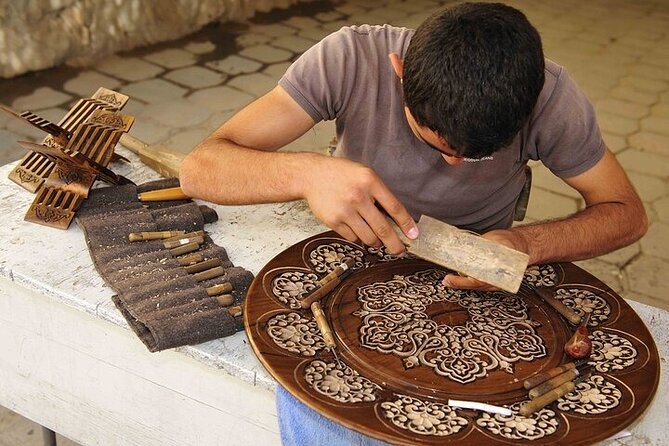
The visit to a local silk workshop offers a change from monuments. The community-supported workshop is run by local women who design and hand-weave Khiva silk carpets. You can see a practical craft tradition rather than only grand buildings. If shopping is part of your plan, this is a useful place to ask about materials, production, and shipping before committing to a purchase.
The difficult part comes afterward. You transfer to Khiva railway station for the train to Bukhara, with departure options listed around 3 p.m. or 6 p.m. and an arrival several hours later. The journey can take about six hours. That makes Day 3 long, but it also avoids a separate road transfer and lets you move directly between two historic centers.
Bukhara: the strongest Silk Road day
Bukhara receives one full guided day, followed by free time. I think that division works well. The first day covers the major monuments, while the second lets you slow down and revisit the streets or markets that caught your attention.
Start at Lyab-i-Hauz, a historic square built around a pool. The old pond and surrounding buildings make this one of Bukhara’s best places to pause. The site is listed for about an hour, and you should use that time to get your bearings rather than rushing straight to the next monument.
The Poi Kalyan complex is the city’s great architectural set piece. The Kalyan Minaret rises 45.6 meters and dates to 1127. The nearby mosque gives you a sense of Bukhara’s former religious and civic importance, while the open space makes the scale easy to appreciate.
The Ark of Bukhara is a fortified royal compound that served as the home of Bukhara’s rulers for more than a millennium. It is not just a fortress wall. It was a town within the town, with the machinery of government and court life inside.
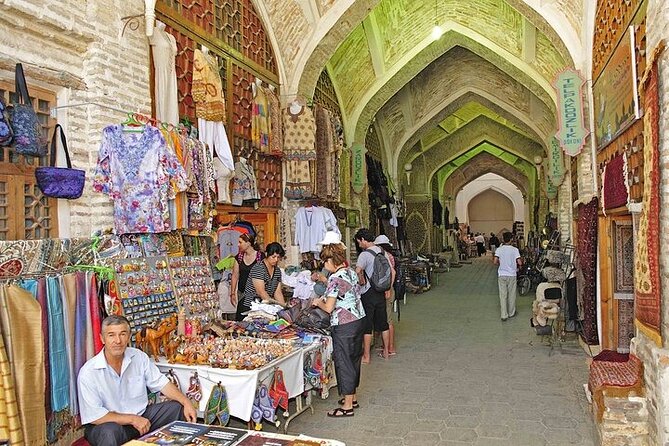
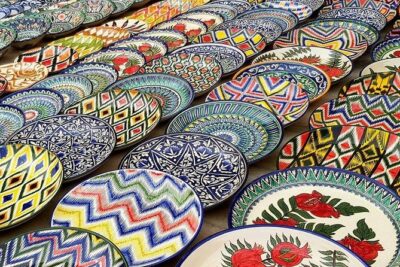
The trading domes bring the Silk Road story down to street level. These old covered market areas now hold artisan workshops and shops. You have about an hour, so compare prices and quality instead of buying the first attractive item you see.
Maghak-i Attari Mosque is especially interesting because the site once served as a Buddhist and Zoroastrian temple before becoming a mosque. Its brickwork and layered past make it more rewarding than a quick photograph stop.
Across from the Ark, Bolo Hauz Mosque is known for its decorated wooden columns and its pool, reflected in the name, which means above the pool. The visit is short, but the setting provides a useful comparison with the grander Kalyan complex.
Same stretch of the Silk Road, a different sort of day:
- Shymkent Day Tour from Tashkent
★ 4.6 · 71 reviews - Highlights of Tashkent (old and new part)
★ 5.0 · 60 reviews - 2 Days Tour to Bukhara and Samarkand from Tashkent by train
★ 5.0 · 53 reviews - Tashkent city tour
★ 5.0 · 50 reviews
Bukhara free time and the optional countryside

Day 5 gives you about four hours in Bukhara without a fixed sightseeing list. This is valuable after two demanding touring days. You can rest, return to Lyab-i-Hauz, browse the trading domes, or take an optional half-day trip outside the city.
The optional excursion includes the Emir’s Summer Residence, the Bakhautdin Naqsband Mausoleum, and the Samanid Mausoleum. It costs extra, but it adds rural and religious context to the city visit. I would choose it if you prefer a fuller schedule and want to see more than Bukhara’s central monuments. If you need recovery time, keep the free afternoon.
Around 3 p.m., you transfer 15 kilometers to Kagan railway station for the high-speed train to Samarkand, subject to availability. The listed train ride takes about three hours. Train schedules can change, so avoid planning a nonrefundable evening activity in Samarkand.
Samarkand: big monuments, close together
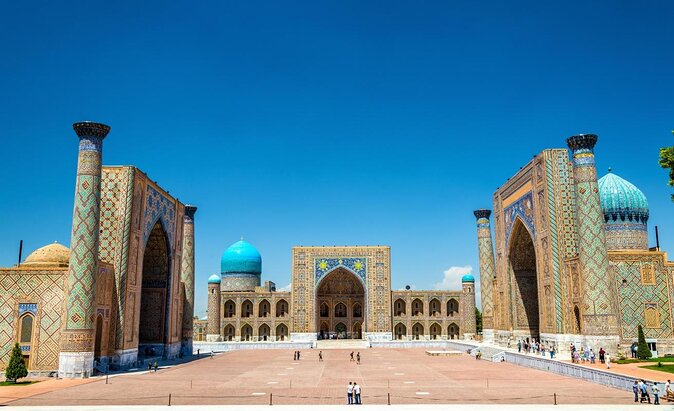
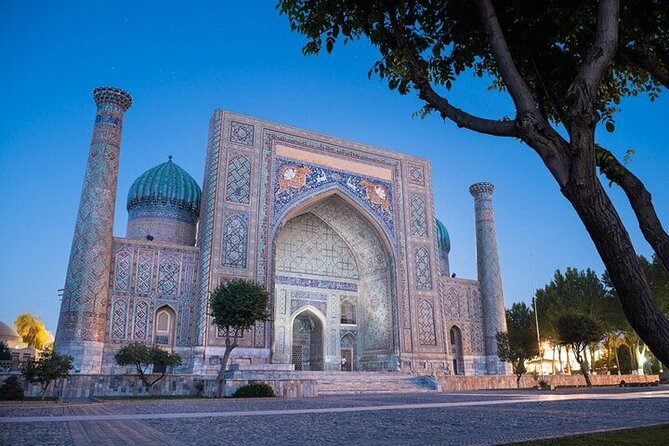
Samarkand’s main guided day is packed with famous sites. Registan gets two hours, which is appropriate. The square is framed by the Ulugbek, Sher-Dor, and Tilla-Kari madrasas, each with its own facade and tilework. Take time to examine the patterns and inscriptions instead of treating the square as a single photo stop.
Gur Emir Mausoleum follows. This is Tamerlane’s tomb, housed in a carefully restored complex dating to 1404 and 1405. The interior decoration and domed form make it one of Samarkand’s essential stops, even if you have already seen grand Islamic architecture in Khiva and Bukhara.
Shah-i-Zinda is another major highlight. The ensemble sits on the southeastern side of ancient Afrosiab and includes 44 tombs spread across more than 20 mausoleums. The narrow route through its blue-tiled facades is visually powerful, but the steps and walking may make it feel more demanding than the time estimate suggests.
Bibi Khanym Mosque was built by Tamerlane between 1399 and 1404 and named for his wife. Its size reflects the ambition of the Timurid period. Like several monuments in Samarkand, it has undergone reconstruction, so your guide can help explain what belongs to the original structure and what has been restored.
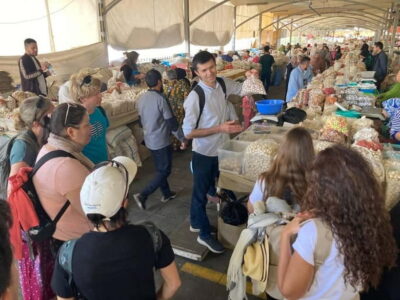
Siab Bazaar gives the day a more ordinary, local rhythm. It is a working market with produce and handicrafts, and it is a good place to see the everyday side of Samarkand after the grand monuments. The tour includes an hour here, enough for browsing and perhaps choosing snacks for the train journey.
Samarkand’s second look and the return to Tashkent
Your second Samarkand day is open. The optional half-day tour includes the Ulugbek Observatory, Afrosiyob Museum, and Hodji Danior Mausoleum. These sites help broaden the city visit beyond the Timurid center.
The observatory and museum are a good match if you want more science and archaeology. The mausoleum offers another religious site with a different setting. If your priority is rest, you can instead spend the four free hours returning to a favorite monument or exploring at your own pace.
Late in the afternoon, you transfer to the station for a high-speed train to Tashkent, again subject to availability. The ride is listed at about three hours. On arrival, a transfer takes you to the hotel or onward according to the arrangement.
The final day is simple: a transfer to Tashkent International Airport for your departing flight. Since the tour begins and ends in Tashkent, it works best if your international flights are arranged with that airport in mind.
How good is the $975 value?
At $975 per person, this is a strong value if you want a guided, organized route rather than separate bookings for every city. The package covers six nights in centrally located three- to four-star or boutique hotels, six breakfasts, city guides, entrance tickets, air-conditioned transport, and the included train journeys.
The domestic flight is the key extra cost. Starting fares are listed at $50, but actual prices may vary. You should also budget for tips, $1 to $2 photography charges at some museums, and $20 per night for a single-room supplement.
The private format matters here. You pay more than you might for a large group departure, but your own group gets a driver and guide rather than a fixed coach schedule. That can make the long transfer days easier to manage.
The tour has a 4.7 rating from 38 ratings and a 97 percent recommendation rate. The strongest praise centers on organization, hotel quality, friendly service, and the city guides. Amir is described as careful and proactive in arranging the trip, while Tulkin, Behrus, Jusra, and Nusrat are specifically praised for their guiding in Khiva, Bukhara, Samarkand, and Tashkent.
Who should choose this Uzbekistan tour?
I would recommend it to first-time visitors who want to see the country’s headline sights without managing domestic transport themselves. It also suits couples, families, and friends who value a private group and want some open time rather than a fixed activity every hour.
You should be comfortable with early starts, airport procedures, station transfers, and long sightseeing days. The tour gives you free time, but it is not a relaxed resort-style itinerary.
Vegetarian food is available in the larger cities, according to the supplied experience notes, though the tour does not include lunches or dinners. You should plan those meals independently and tell the operator about dietary needs before arrival.
The cancellation terms are friendly: cancel at least 24 hours before the local start time for a full refund. Changes or cancellations inside that window are not accepted for a refund.
FAQ
How long is the Uzbekistan private tour?
The tour lasts eight days and covers Tashkent, Urgench, Khiva, Bukhara, and Samarkand.
Is the Tashkent to Urgench flight included?
No. The domestic airline ticket is not included. Prices are listed from $50 per ticket.
Are hotels included?
Yes. The package includes six nights in twin rooms at centrally located three- to four-star or boutique hotels. A single-room supplement of $20 per night applies.
Are train tickets included?
Yes. The Khiva to Bukhara train and high-speed trains from Bukhara to Samarkand and Samarkand to Tashkent are included, subject to availability.
Are breakfasts included?
Yes. Six breakfasts are included.
Are entrance tickets included?
Entrance fees and tickets for the listed sights and museums are included. Some museums charge a separate photography fee of about $1 to $2 per site, paid in cash.
Is this a private group tour?
Yes. Only your own group participates, with guides arranged in each city.
Should you book it?
Book this tour if you want the essential Silk Road route in eight days, with the hard logistics handled for you. The best reasons are the private format, the included rail travel, the strong city coverage, and the access to local guides such as Tulkin, Behrus, Jusra, and Nusrat.
Skip it if you want long stays in each city or dislike tightly scheduled transfer days. The Khiva to Bukhara train is especially demanding, and the Tashkent to Urgench flight costs extra. For most first visits, though, the $975 package offers a practical way to see Uzbekistan’s major historic centers without spending your holiday sorting out every ticket and transfer.
Freshly added in Tashkent
- Uzbek Brews & Views: Tashkent Craft Beer Discovery Tour★ 5.0 · 2 reviews
- Uzbekistan Tour – 6 Days 5 Nights★ 5.0 · 4 reviews
- Tashkent International Airport (TAS) to Tashkent – Arrival Private Transfer★ 5.0 · 2 reviews
- 8-Day Private Tour in Uzbekistan with Pick Up★ 5.0 · 2 reviews
- Tashkent-Samarkand-Bukhara tour-3nights/4 days★ 5.0 · 5 reviews
- Tashkent Food and Metro Journey★ 5.0 · 4 reviews
- Private Intercity Transfer Tashkent – Samarkand – Tashkent★ 3.5 · 3 reviews
- Private Tashkent City Tour★ 5.0 · 3 reviews
Tashkent Tours, compared.
Best of Tashkent Mountains: Amirsoy, Chimgan & Charvak Trip
Read our review →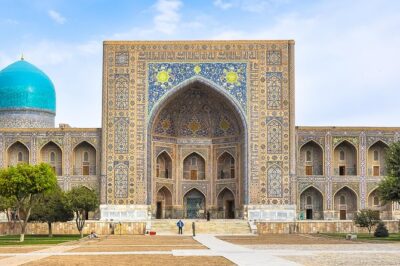
Samarkand One Day Tour – Departure From Tashkent
Read our review →
2 Days Tour to Bukhara and Samarkand from Tashkent by train
Read our review →
Browse the lists this tour appears in